December 23, 2014

Coin Grading Services Are Not All Equal.

Have you noticed that a coin graded by one grading service as MS65 will sell for a dramatically different price than the same coin graded by another service as MS65? A great deal of the difference is the different quality the market assigns to coins graded by one service versus another service. One grading service (GEC) Grade Evaluation Co. only grades coins as MS67 no other grade.

PCGS, NGC, ICG, and ANACS are generally recognized as the most reliable grading services in terms of the quality and consistency of their grading. While coin grading is very subjective, consistency in grading is necessary if the investor is to make rational decisions when investing in coins. Most coin grading companies attempt to comply with the grading standards established by the American Numismatic Association (website numismatics.org).  The market seems to believe that these four services accomplish these standards the best. The market frequently discounts other grading services by one or more grades.

Unfortunately, there are a number of grading services whose coin grading is virtually useless. When I first started buying on e-bay I purchased a 1923 S Peace Dollar that was graded by HCGS (Hallmark Coin Grading Service) as an MS66.  When I received the coin, I could not believe my eyes.  There were clear signs of wear and virtually no detail in the hairline or the breast feathers. Most of the mint luster was gone.  I showed it to a local coin dealer whose opinion I respect and he had a good laugh. He agreed with my estimate that the coin would be graded at best as an AU50 and possibly as low as an XF40 by PCGS, NGC, ICG,or ANACS.

Fortunately mine and other e-bayer guides warning of HCGS has driven most HCGS graded coins out of the e-bay market. Likely the sellers have had them re-slabbed by another third class grading services. There are plenty of con artists that will change their names and open up a new grading service. Just in the last year a NEW grading service has appeared with MANY coins (Grade Evaluation Co.), but all of the GEC (Grade Evaluation Co.) coins are graded as MS67. They apparently do not issue a grade lower than MS67. If you believe that all their MS67 coins are true MS67 coins, I have some swamp land in Florida I would like to sell to you.

I did a recent search for peace dollar listings where the coin was “Certified” by a grading service as MS66 or MS67. There were 18 (eighteen) MS67 peace dollars and 45 (forty-five) MS66 peace dollars found in this search. Of the eighteen MS67s only 1 (ONE) had been graded MS67 by one of the top four (PCGS, NGC, ICG, or ANACS) and only 6 (SIX) of the 45 peace dollars graded MS66 had been graded by one of the top four. When you look at the remaining grading services for the MS66 and MS67 peace dollars almost invariably, the grading services with the greatest number of MS66 and MS67 coins on e-bay are the WORST GRADING SERVICES in terms of quality.

Please remember, when e-bay coin dealers indicate a price trends for the coin they are selling, they are almost always using the PCGS price guide, which is the retail price PCGS estimates a PCGS graded coin will sell for in that grade. However, frequently the same grade of coin graded by a grading service other that PCGS, NGC, ICG, or ANACS will command a dramatically lower price.

While the values of PCGS, NGC, ICG, and ANACS graded coins might approach the price trends for a date and mint mark, other grading services will be discounted by the market from the price paid for coins graded by PCGS, NGC, ICG, and ANACS.  This discount can be as little as two grades and as much as 4 or 5 grades or more depending on the value the market sets for a particular grading services opinion. Please remember the PCGS price trends are the top average RETAIL PRICE a particular coin should sell for.  On e-bay even PCGS graded coins are usually sold at a discount to the trends unless it is a particularly rare date. Even then recently I saw a very rare date PCGS Peace Dollar sell for significantly below bluesheet wholesale (wholesale prices for graded coins – see greysheet.com).

While there are four quality grading services, there are MANY DOGS, Hallmark Coin Grading Service (HCGS) is an example. There are to many UNRELIABLE grading services to name, but NNC, ANI, TRUGRADE, INB, PGS, GEC, HCGS PEGS, SGS,etc. are just a few. The coin dealers newsletter (at greysheet.com) gives a percentage ranking of the major grading services. If the grading service you are considering IS NOT rated in the top four on the greysheet WATCH OUT.

Recently I received a message from an e-bayer who had bought a number of SGS graded modern coins that were all graded MS70. When he received the coins he found surface sratches and said they clearly had been overgraded by a number of grades. He promptly returned the coins. Always return coins that you feel do not meet the ANA grading standards even if a grading service has slabbed them as MS70.  However, please think twice about returning a PCGS, NGC, ICG, or ANACS graded coin since they are the most reliable grading services. If you disagree with their grading educate yourself on the ANA standards. I personally no longer accept returns on these four grading services.

To show how incompetent some grading services can be,  I recently found a coin on e-bay where the date on the slab was not the date of the coin contained in the slab (An SGS graded coin). If a coin grading service can not properly read the date on a coin how can you rely on their grading?

Regarding ICG, this is the newest of the most reliable grading services, but the market is giving a very positive response to ICG graded coins and ICG is well rated by greysheet.com.   I have been told by another e-bayer that ICG is different from PCGS or NGC in that their officers and employees are prohibited from trading privately.  This should helps minimize conflicts of interest in assigning grades. I have not yet had the time to checkout all the grading services policies regarding private trading by their graders but it is a great policy if true.

SO BUYER BEWARE, unless you are familiar with the quality of the grading service for the coin on which you  are bidding. Please note, some of the grading services with the most coins on e-bay have some of the poorest quality of grading. If you wish to bid on one of the less desireable grading services you should deduct three or four grades at a minimum in evaluating the coins you are considering. As I mentioned in my example above, even though I bid as though the HCGS coin was an MS60 instead of the MS66 shown, I still got stuck, since the coin was less than AU.

Regarding NNC Grading Service (National Numistmatic Certification), if you read their website they appear to have a tolerance level for cleaned coins, that other grading services do not. Avoid NNC graded coins if possible. If you bid on an NNC coin discount the grade by at least six or seven grades.

peacedollarguy, ebay

http://www.ebay.com/gds/COIN-GRADING-SERVICES-ARE-NOT-ALL-EQUAL-/10000000001628812/g.html
December 10, 2014

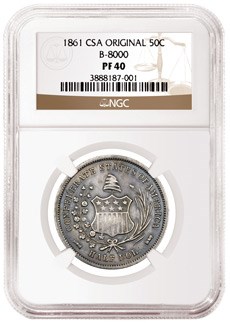
NGC Certifies Kendall 1861 Confederate Half Dollar

The Kendall specimen of the Original 1861 Confederate States Half Dollar now sits atop the NGC Census as finest certified.
Numismatic Guaranty Corporation® (NGC®) has announced that it has recently graded one of the four extant original 1861 Confederate Half Dollars. Graded NGC PF 40, this important Confederate issue will be auctioned by Stack’s Bowers Galleries in March 2015 as part of a collection sold to benefit the Henry P. Kendall Foundation.
Incredibly, NGC’s certification of the Kendall specimen comes immediately upon the heels of NGC’s announcement that it graded an original 1861 Confederate Half Dollar from the Donald G. Partrick Collection. The Partrick specimen, which is graded NGC PF 30, was acquired in October 2003 from the Stack’s Bowers Galleries John J. Ford Collection sale.
The 1861 Confederate Half Dollar is a spectacular rarity and examples are typically seen only once a generation, if that often,” says Mark Salzberg, chairman of NGC. “For NGC to have been selected to certify both the Kendall and Partrick specimens in the span of a month is a humbling testament to the confidence in NGC’s grading. Coins like these are the reason I have stayed a professional grader for nearly three decades.1861_CSAOriginal_50C_obvtb1861_CSAOriginal_50C_revlg
Only two other original 1861 Confederate Half Dollars are known. One is in the museum of the American Numismatic Society, while the other is held by Eric P. Newman Numismatic Education Society.

The four original Confederate half dollars were struck at the New Orleans Mint in April 1861 on the order of C. G. Memminger, the Treasury Secretary of the Confederate States of America. A confiscated 1861 Seated Liberty die with prominent die cracks was used for the obverse, while a new die that featured a “Confederate States of America” legend was used for the reverse. Four proofs were struck and presented to Confederate dignitaries pending approval from Memminger, which never came.
The Kendall 1861 Confederate Half Dollar was originally presented to a professor of chemistry at the Medical College of Louisiana, who also served as a refiner at the New Orleans Mint. After trading hands several times over the next century, it was sold in 1971 to the coin’s present owner.

October 28, 2014

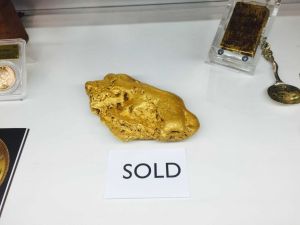
Giant gold ‘Butte Nugget’ sells to secret Bay Area buyer.

920x680

Just one day after it was unveiled to awed crowds in San Francisco, the whopping ‘Butte Nugget’ of gold sold Friday to a “prominent Bay Area collector” for an undisclosed amount of money, according to the company brokering the deal.
“The new owner wants to be secretive, so we can’t name him,” said Don Kagin of Tiburon, the coin dealer who acted as middle-man between the buyer and the prospector who found the 6.07-pound gold lump — the biggest nugget of its kind found in modern times in Gold Rush country.
“Let’s just say it’s a win-win for everybody,” Kagin said.
The seller also asked that the price be kept secret, he said. But he added: “We were asking for $400,000 and it obviously wasn’t far from that.”
David McCarthy, Kagin’s chief numismatist, said he could only reveal that the buyer is “a prominent bay area collector” who specializes in historical items.
“We spoke to six different people who seemed to have legitimate interest and the wherewithal to purchase the item, but he was the first person to make an offer and he had the right price,” McCarthy said.
Interest in the nugget had built to a near frenzy among gold and history buffs since its existence was revealed in The Chronicle on Tuesday, with news inquiries coming in from as far away as Australia. When it went on display Thursday at the prestigious San Francisco Fall Antiques Show, hundreds flocked in for a peek.
The nugget — which will remain on public display until the antiques show ends Sunday, McCarthy said — got its name because the gold hunter who found it in July dug it out of the ground in Butte County. That man also wanted his name and the location of the find to be secret, to avoid scammers and treasure seekers.
“But I can say he’s very pleased with the sale,” McCarthy said.

http://www.sfgate.com/bayarea/article/Giant-gold-Butte-Nugget-sells-to-secret-Bay-5846149.php

June 20, 2014

Gold And Oil Prices Surge As Tensions In Iraq Escalate

goldoil

Forbes

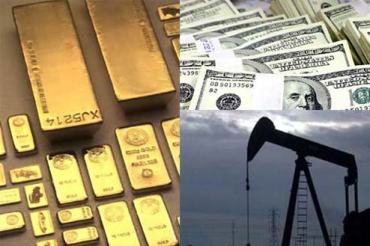
With tensions in Iraq escalating to the point that President Obama said he would deploy up to 300 military advisers to the country, investors sent prices of gold and oil surging in Thursday trading. Gold, the classic safe-haven trade, reached its highest point in two months as oil, whose Iraqi production could see pressure if ISIS (Islamic State of Iraq and Syria) militants move the conflict to the south of Iraq, surged to its highest price of the year.
Bolstered by a drop in the dollar and the Federal Reserve’s reticence to raise interest rates — not to mention the situation in Iraq — gold gained 3.7% in Thursday trading and surged to its highest price in two months. Gold futures, which hit as high as $1,322 an ounce during its regular trading session, settled at $1,314.10 for the day, its highest level since April 14. Spot prices, too, closed at $1,314 an ounce.
Surging even more than gold on Thursday was oil: brent crude hit $115 a barrel, its highest price of the year, as WTI crude oil finished the day at more than $106 a barrel, a dollar short of the 52-week high it hit last week.
The ETFs that track these commodities – SPDR Gold Shares, United States Oil and iPath S&P GSCI Crude Oil Index — saw gains roughly commensurate with those of the commodities themselves. GLD finished Thursday trading with a 3.5% gain, US Oil clos
ed 0.3% up and the iPath index finished the day with an 0.4% uptick.
Stateside, oil’s increases paired with the impending summer months and summer travel in the U.S. to send prices at the pump for a surge of their own. The national average for one gallon of gas in the U.S. is $3.68, up from $3.60 a gallon this time last year and the highest levels consumers have seen at the pump in June since 2008.
“Oil is the lifeblood of a modern economy. Estimates vary, but each $10 increase per barrel can knock off about 0.2% from economic growth,” Brad McMillan, chief investment officer for Commonwealth Financial Network, said in a note Thursday. “With U.S. growth currently expected to fall in the 3-percent range, this is significant. Oil prices have risen by about $3 over the last month, and they could be headed higher as the conflict worsens.”
The reason for the price surge in the wake of violence in Iraq is that the country produces a not-insignificant amount of oil, and if Iraqi oil fields are taken over and closed, global oil supply could shrink and send prices even higher. The Organization of the Petroleum Exporting Countries (OPEC) recently projected that Iraq would be accountable for 3 million barrels of oil production a day for the second half of 2014, ranking the country as OPEC’s second-largest producer. The somewhat good news is that most of Iraq’s production occurs in the southern part of the country, and with the exception of the Baiji refinery (115 miles outside of Baghdad) — which Iraqi officials say they do have control over — ISIS has not ventured in this territory.
“[We do not] expect ISIS to make much headway in the south, where the Sunni extremist group would be running into the Shi’ite heartland,” wrote Citi analyst Seth Kleinman in a note on Thursday. He noted that investors are on edge “for good reason, as the world would struggle to replace the lost oil volumes if Iraq were to go the way of Libya.” However, he pointed to accelerating exports in the Kurdish region as well as the low likelihood that ISIS reaches the south of Iraq as reason to be less concerned about oil’s future price.
“Iraq’s key oil fields are southeast of Baghdad, and Citi does not expect ISIS to get as far as Baghdad. Some oil companies are removing non-essential staff but Basra operations and exports continue, and continue to make new highs with July loadings set at 2.8 million barrels of oil per day,” Kleinman said.
If ISIS does venture south, however, prices could rise rapidly.
“Given how fast everything has transpired, if this were to spread into the south and impact exports it could be very dramatic,” said Chad Mabry, a director and oil and production analyst at MLV and Company, in a phone interview. “This isn’t hyperbole, it could easily send global markets back into recession with the impact. We could be looking at a significant rise in prices if those barrels were taken off the world market.”
Mabry notes that due to sanctions that have limited production in Iran and violence that has limited production in Libya, “you don’t have much room for error within OPEC anymore because the burden then falls on Saudi Arabia to make up that delta.”
If there’s one bit of good news amongst all the Iraqi turmoil, it’s this: the U.S. has increased its production of oil and energy independence since the start of the last Iraqi conflict (which began in 2003), so the market’s reaction is not as bad as it would have been if this were to have happened even five years ago.
“The U.S. economy is significantly more energy efficient than it used to be, so the effects of price changes are simply smaller,” says Commonwealth’s McMillan. “Energy consumption per dollar of GDP has been cut almost in half since 1970. Although the relationship isn’t linear, any effect from rising oil prices should be materially less than it has been in the past.”

April 3, 2014

Early Liberty Gold 40% Higher Than PCGS Price Guide

February 26, 2014

California couple finds treasure trove worth $10 million


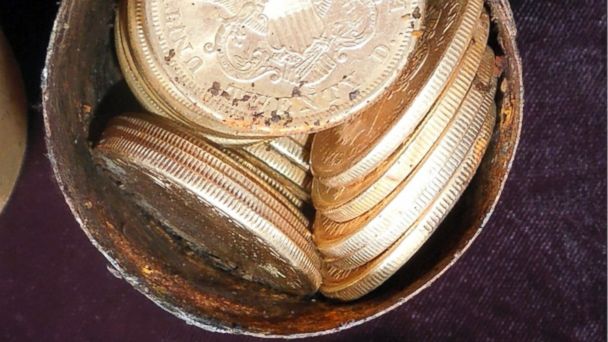
Los Angeles:  A California couple out walking their dog struck it rich by unearthing a horde of buried gold coins, worth more than $10 million according to experts.

The so-called Saddle Ridge find is believed to be the most valuable treasure trove ever discovered in the United States, according to Kagin’s Inc, which specializes in ancient gold coins.

The couple, named only as John and Mary, spotted a partially buried can jutting out of the ground – and after further digging found seven more, with more than 1,400 gold coins.ap_gold_cins_tight_kb_140225_16x9_608

“This family literally found the pot of gold at the end of the rainbow,” said company boss Donald Kagin, adding that most of the coins date from the late 19th century.

“What’s really significant about this find… is that unlike other hoards and treasures, this one includes a great variety of dates, many of which are in pristine condition,” he added.

The Saddle Ridge Treasure is named after a feature on the couple’s property in an area of northern California known for buried treasure since the Gold Rush in the 19th century.

The couple said they were simply taking their dog for its daily walk when they made the first find.

“I saw an old can sticking out of the ground on a trail that we had walked almost every day for many, many years,” said John, who used a stick to dig it out.

They carried it back to the house, despite its considerable weight.

“I said to Mary, ‘Wow, this thing is heavy. It must be full of lead paint.’ I couldn’t figure out what in the world would weigh that much,” John said.

At that moment, “the lid cracked off and exposed a rib of a single gold coin,” he said, adding: “I clamped the lid back on – I found a can of gold coins and I thought there was a zero percent chance of Mary believing me!

“When I told her, the look of bewilderment – her mouth was so wide open flies could have flown in and out several times.”

Mary added: “I never would have thought we would have found something like this. However, in a weird way I feel like I have been preparing my whole life for it.”

After further digging, including with a metal detector, they eventually unearthed eight cans.

The couple, who are around 40, have decided to remain anonymous for the moment.
628x471
“Like a lot of people lately, we’ve had some financial trials. I feel extreme gratitude that we can keep our beloved property,” John said.

Mary added: “we’re the same people we were before, just with more freedom of choice.

“Our finances won’t have to dictate so many of our day-to-day decisions… The answer to our difficulties was right there under our feet for years. Don’t be above bending over to check on a rusty can!”

February 12, 2014

Keystone State Shipwreck: Civil War era wreck discovered in Lake Huron

By Tracey Parece, examiner.com

The Keystone State shipwreck is the remains of a Civil War era ship that was discovered earlier this year in Lake Huron. For more than 150 years, the location of the wreck was a mystery. It sank to the bottom of Lake Huron in the year 1861 with 33 souls aboard. All of them perished.ny2-large

According to a Dec. 9, 2013 report by USA Today, David Trotter, a 72-year-old veteran shipwreck hunter located the Keystone State shipwreck at the bottom of Lake Huron in July, however the discovery didn’t catch the media’s attention until December. This latest triumph marks nearly 100 shipwrecks found by Trotter, who has been a shipwreck hunter in the Great Lakes for more than 3 1/2 decades.ny1

Undersea Research Associates, Trotter’s official website, made the official announcement about the discovery of the Keystone State shipwreck with the posting of a YouTube video entitled “Desperate Voyage.”

The discovery and exploration of the 288′ sidewheel steamer Keystone State, lost with all hands in November, 1861. Abruptly leaving Detroit for Milwaukee, Wisconsin, her cargo appears to be very mysterious and she is also reported to be carrying gold bullion/coins. The Keystone State has long been one of Lake Huron’s most mysterious ships…………..missing for 150+ years.ny3d

Trotter has been quoted as saying that he didn’t think he would ever find the wreck. Fortunately, he was wrong.

The Keystone State began life in 1849 as a luxurious steamer measuring nearly 300 feet in length that featured a walking beam engine, giant paddlewheel and twin stacks. The steamship belongs to a class called palace steamers, and it counted leaded glass windows, mahogany trim and carved arches among its details. The interior of the ship was designed to resemble a fine hotel.

In 1857, the Keystone State was set aside due to its high cost of operation. It languished until the star of the Civil War in 1861, when it was refurbished and put to use as a cargo ship. It traveled to Detroit, picked up a load that may have included Civil War supplies including munition, and then headed for Milwaukee. Some time around Nov. 9, 1861, the ship disappeared with its cargo and crew on board.

No one even noticed that the ship was missing until another ship noticed debris from the Keystone State. Debris from the shipwreck also washed ashore near Lexington.

Now, the Keystone State shipwreck lies beneath 175 feet of water. It is covered with zebra mussels, and the stern is badly damaged. However, the engine and the boilers are reportedly in good condition, sitting upright on the bottom of the lake.

Although the manifest for the ship list such mundane objects as barrels of grain, farm implements and iron hardware, some people believe that there is treasure, in the form of gold, lying at the bottom of Lake Huron.

January 28, 2014

Rare Coins Lure Emerging Market Buyers to N.Y. Convention

By Katya Kazakina Jan 10, 2014
http://www.bloomberg.com/news/2014-01-10/rare-coins-lure-emerging-market-buyers-to-n-y-convention.html

BLOOMBERG
Never mind the Bitcoin craze. Gold and silver coins starring Russian czars, Chinese leaders and Roman emperors are igniting bidding wars as numismatic buffs compete with investors and wealthy collectors from emerging economies for the tiny relics.
Heritage Auctions set a record this week for a Brazilian coin sold at auction when a gold 1822 piece depicting the country’s first Emperor, Pedro I, fetched $499,375 in New York, said Cristiano Bierrenbach, the Dallas-based company’s head of world coins. Six of the 10 bidders were from Brazil. A 1711 Mexican Felipe V gold royal cob 8 escudos brought $293,750.
The sales were part of the 42nd annual New York International Numismatic Convention, the largest international gathering of dealers and auctioneers in the field of ancient and world coins. The event, running through Jan. 13 at the Waldorf Astoria Hotel, showcases an increasingly global market for the collectibles. In addition to a series of auctions, it includes 120 dealers hawking coins dating back to ancient Greece.
“Collecting coins used to be more of a hobby,” said Kevin Foley, the convention’s bourse chairman. “Now it’s an investment area, with people paying millions for coins.”
The most expensive Russian coin at auction fetched $4.4 million at Sincona AG in 2012.
The most expensive coin at auction, a 1794 Flowing Hair silver U.S. dollar, fetched $10 million at Stack’s Bowers Galleries last January in New York. In 2012, an anonymous collector paid $4.4 million for a 1740 Russian coin at Zurich-based Sincona AG, the auction house said.igCvrXEUri.k
“There is an increasing pool of bidders and buyers from China, Russia, Eastern Europe, India and Latin America,” Bierrenbach said.

“It’s people who are coming up in the upper middle class and have more disposable income.”
Heritage Auctions sold $37 million of world and ancient coins in 2013, a 131 percent increase from 2008.
Historic significance is one appeal of rare coins; size is another. Unlike such larger collectibles as fine art, antiques, wine and automobiles, coins are easy to store and transport.
“You can have tens of millions in rare coins and keep them in your safe deposit box,” said Brian Kendrella, president of Irvine, California-based Stack’s Bowers.

Numismatic Guaranty Corp., headquartered in Sarasota, Florida, will authenticate, grade and encase any coin for a fee of $14 to $600, according to Max Spiegel, the company’s vice president of sales and marketing. If it turns out to be a fake, the company will buy the coin for the current market value.
Bierrenbach said Heritage Auctions sold $14.6 million of ancient and world coins earlier this week and expects more than $5 million in transactions at the Jan. 14 sale of 1,900 world coins from the trove of Eric P. Newman, a 102-year-old collector from St. Louis.
Russian and ancient coins brought $6.5 million during a two-day sale that ended at 1 a.m. today at the convention, said Dmitry Markov of New York-based Dmitry Markov Coins & Medals, which organized the sale with London-based Baldwin’s Auctions Ltd. and M&M Numismatics Ltd. in Washington.
The top lot was an 1876 gold 25 rubles coin commemorating the 30th birthday of Russian czar Alexander II’s son Vladimir, Markov said. It fetched $325,000, surpassing the presale estimate of $200,000.
More than a half of all lots went to Russian buyers, Markov said.
Roman coins are popular with international collectors, including those from Russia and China.
Classical Numismatic Group Inc., which has offices in London and Lancaster, Pennsylvania, said it sold $6.35 million of classical and ancient coins in a four-part sale that exceeded its presale target by 63 percent. The top lot was a gold coin from the reign of Roman Emperor Probus (276-282 A.D.) that fetched $190,000 against the presale estimate of $75,000.
Four live auctions by Stack’s Bowers Galleries begin today at the Waldorf Astoria. One highlight is a machine made, 1755 Colombian coin estimated at $100,000 to $150,000.
“In the past five years there’s been a wider acceptance of rare coins as a collectible,” Kendrella said. “Anybody who is our customer looks at investing as a component of their purchase.”

December 11, 2013

The Incuse Design of the $2.50 & $5.00 Indians

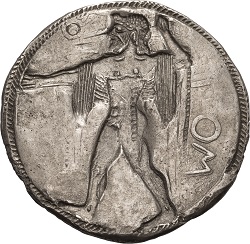
The first Greek coins, like those of Lydia, were incuse on one side and were stamped with the badge of a city or a deity. After its adoption by Argos and Athens, coinage spread quickly to the Greek coastal cities of the Mediterranean during the 6th century BC.
Poseidonia 2 O
Early Greek coinage is characterized by its high relief and exceptional engraving. The artistic quality of coinage was a matter of great importance to the Greek city-states as coins became a focus of civic pride and a mark of political independence. Designs were chosen based on the patron deity of a city or products associated with it or on punning allusions to the city name so that the coins would be easily recognized as having come from that city. Over time as more cities began issuing coins, legends began to be added to make their origins more clear.
Poseidonia 2 R
The Greeks of Southern Italy (Magna Graecia) and Sicily began to adopt coinage during the middle of the 6thPoseidonia 2 R century BC.  However, a group of cities did not simply copy the form of the coins that they learned about from the cities of Greece proper – instead they introduced an innovative method of striking coins.  This method involved the production of coins with a raised design on one side and a mirror image of the same design in incuse on the reverse. Incuse-550-510-BCThe process of making these coins was more complicated than the usual method as it required more care in engraving so that the obverse and reverse dies would match and that the dies be properly aligned during striking in order to produce an acceptable result. The problem with these requirements is that the extra skill and care necessary to create the coins made them more expensive to produce. Coins of this type were no longer produced by the middle of the 5th century BC.

Fast forward to January 1914, with Europe on the brink of war and the United States in the throes of a depression, Henry Ford announced that he was doubling his workers’ pay from $2.34 per day to a princely $5 and, at the same time, reducing their nine-hour workday to eight hours. Ford Motor Company was, he said, initiating “the greatest revolution in the matter of rewards for its workers ever known to the industrial world.” Strange as it may seem in today’s inflated economy, $5 per day was indeed a handsome wage in 1914, and what Ford did was every bit as revolutionary as he proclaimed.5ind

Clearly then, the half eagle—or $5 gold piece—was a coin with considerable clout in 1914, even though it was only slightly larger than the then brand-new “Buffalo” nickel. After all, it represented a full day’s pay for well-paid workers—enough to buy a pair of trousers plus a pair of work boots.

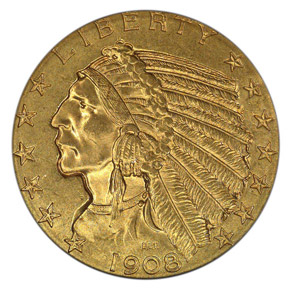
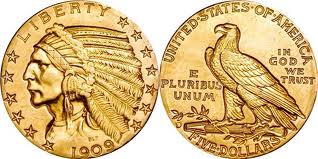
The half eagles being minted that year had more in common with Buffalo nickels than size: Both carried portraits of realistic-looking American Indians. The Indian Head half eagle had made its first appearance in 1908, along with a quarter eagle (or $2.50 gold piece) of identical design.

In another respect, however, these Indian Head gold pieces are unlike any other coins produced before or since by Uncle Sam: Their designs and inscriptions are sunken below the surface of the coins, rather than being raised. This innovative technique was quite daring, for no other modern coins had ever used it. In normal times, in fact, the idea might well have been scrapped. But new ideas were welcome in national affairs in the early 1900s, thanks in large measure to one larger-than-life individual: President Theodore Roosevelt. The restless, dynamic Roosevelt took a personal interest in virtually all aspects of the American scene—including the nation’s coinage—and left his personal imprint on many areas.

Roosevelt had persuaded the nation’s foremost sculptor, Augustus Saint-Gaudens, to redesign the double eagle and eagle ($20 and $10 gold pieces) and had taken great pride when the two new coins debuted in 1907 to rave reviews. In 1908, he turned his attention to the two remaining gold coins, the half eagle and quarter eagle.

The idea of recessing the coins’ features came from William Sturgis Bigelow, a Boston physician and art lover who happened to be a close friend of Roosevelt’s. Bigelow had seen incuse relief in Egyptian art works at the Boston Museum of Fine Arts, and he piqued the president’s interest with his notion of adapting this technique to U. S. coinage. With Roosevelt’s blessing, he engaged a fellow Bostonian, noted sculptor Bela-Lyon Pratt, to prepare coinage models, and Pratt developed designs pairing an Indian brave on the obverse with an eagle in repose on the reverse.

The new coins must have bewildered many Americans when they first entered circulation near the end of 1908. Beyond their unusual relief, they also represented the first fundamental design change in the two denominations in nearly 70 years. Other than the addition of the words IN GOD WE TRUST in 1866, the previous half eagle—which carried a portrait of Liberty with a coronet in her hair—had been basically the same since its origin in 1839.

Consternation, not confusion, was what some people felt when they saw the coins. One of the loudest critics was Philadelphia coin dealer Samuel H. Chapman, who took issue with everything from the virility of the Indian (he described the portrait as “emaciated”) to the health hazard posed by the “sunken design” (he predicted that this would make the coins “a great receptacle for dirt and conveyor of disease”).

Critics such as Chapman were doomed to disappointment in their bid to derail the new coins, although they had an influential ally in the U. S. Mint’s chief engraver, Charles E. Barber. Jealously defending his turf, Barber did make seemingly unneeded modifications in Pratt’s designs, just as he had done earlier with Saint-Gaudens’ models. But in the final analysis, Roosevelt’s support was all that mattered.

Indian Head half eagles were issued annually from 1908 through 1916; in one year, 1909, four different mints produced them (branch-mint issues are denoted by a mint mark to the left of the fasces on the reverse). After 1916, production was suspended for 13 years; it then resumed for one last hurrah in 1929 at the Philadelphia Mint before the series ended for good in the face of the Great Depression. The 1929 half eagle is the big key in the series, worth several thousand dollars even in circulated grades. Records list its mintage as 662,000, but the vast majority apparently were melted. Other scarce dates include 1909-O, 1911-D and 1908-S, all with mintages under 100,000. Small numbers of matte proofs were made every year from 1908 through 1915.
index
Being recessed, the design elements on Indian Head half eagles are shielded from heavy wear. At the same time, this complicates grading since wear patterns differ from those of raised-relief coins. Critical areas for detecting wear are the Indian’s cheekbone and headdress feathers and the shoulder of the eagle’s left wing. Although these coins are plentiful in grades up to Mint State-64, they are quite elusive in MS-65 and very rare above that level.

Though its innovative design met with mixed reviews, the Indian Head half eagle was saved in its first year of issue. The Philadelphia Mint pieces of 1908 represent one of the most available dates of this series in mint state. All other issues seem to have survived in this condition by mere chance. Easily the most commonly seen mint state examples of this type are those dated 1909-D. Thousands turned up in a hoard some years ago though, not surprisingly, precious few were gems.

While coins of this type were generally well struck, the same did not apply to their mintmarks. As the only elements raised above the level of the field, these tiny letters are often found shallow and indistinct. Only slight wear can render them unreadable. This is especially true of the San Francisco Mint coins, though the 1909-O half eagle is likewise notorious for having a mintmark that’s difficult to distinguish, even on mint state coins.

Henry Ford probably wasn’t thinking of the Indian Head half eagle when he instituted the $5 workday, yet the coin’s career did seem to parallel Ford’s: It came into being the same year as the Model T, and it left the Mint’s production line two years after the Model T gave way to the Model A.

November 20, 2013

Eric P. Newman Collection Exceeds Pre-Auction Estimates

The landmark sale of the Eric P. Newman Collection Part II shattered expectations when it realized a total of nearly $23.4 million, or more than 50% above the pre-sale estimate, when it was sold by Heritage Auctions in New York on November 15 and 16. 1,827 coins were selected from the collection of noted numismatic writer and researcher Eric P. Newman.newman_25c_thumb
“These outstanding results are a clear indication of the strength of the rare coin market”, said NGC Chairman Mark Salzberg.
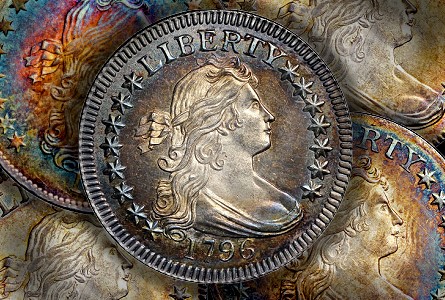
The top lot in the Newman Part II sale was a gorgeous 1796 Quarter graded MS 67 that sold for $1,527,500—a new record for a silver minor coin and the second coin from the Newman Collection to sell for more than $1 million. The finest known example of this coveted first-year issue was purchased by Newman for only $100 in the early 1940s.

Newman’s 1799 7×6 Stars Dollar graded MS 67 realized $822,500, a record price for its date. The piece was originally purchased by Newman for $75.
Newman’s exceptional No Motto Seated Liberty Quarters also achieved a number of record-breaking results. These selections were led by his 1840-O No Drapery Quarter, which at MS 67 is a full two points above the next finest example. It sold for $329,000 or more than 12 times the previous auction record for this date.
The finest known Proof 1861 Quarter, graded PF 68 Cameo, sold for $188,000. The previous auction high for a Proof 1861 Seated Liberty Quarter was $16,100.
Another notable specimen was Newman’s 1838 No Drapery Quarter graded MS66, which sold for $141,000. This result was nearly triple the price paid for a higher graded example of this date just four years ago.

newman
“Mr. Newman had an amazing eye for rarity and quality that was far ahead of his time,” adds Salzberg, chairman of NGC. “His incredible understanding of these nuances enabled him to assemble one of the greatest collections in history.”

Newman is well known among numismatists for his scholarly contributions and his generosity is further shown by the donation of all proceeds from the sale to charitable pursuits.
The next installment of the Eric P. Newman Collection will be sold in New York, January 14 to 16, 2014. The highly anticipated Newman Part III will include selections from Newman’s world coin collection.