April 5, 2013

WW II Walking Liberty Half Dollars

wwii-special-edition-palliserlabs

In 1941 The United States entered World War II by declaring war on Japan after the bombing of Pearl Harbor on December 7th.  Collectors and investors have been pursuing a representation of Walking Liberty Half Dollars produced during the war years. The “Walker”, as it is affectionately called in the market, was the largest denomination coin minted at the time. They also represent an opportunity to invest in an undervalued area of the rare coin market! A 15 coin set of Walkers from all three mints (Philadelphia, Denver & San Fransisco) represent all the years the United States were involved in WWII. Many collectors also include the two years prior to Pearl Harbor. In 2016, the 75th anniversary of Pearl Harbor will be commemorated. Most expect the attention such an anniversary will draw to significantly increase the demand and value of these important issues.

  Historical Eventsh86118
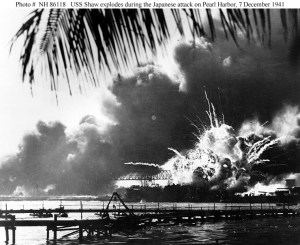
1941:  December 7th Attack on Pearl Harbor

1942:  First American Forces Arrive in Africa; Battle of

           Midway in the Pacific

1943:  U.S. invades Sicily and Italy

1944:  Operation Overlord (D-Day) liberates France &

           weakens Nazi hold on Europe

1945:  May 8th Germany surrenders; Atomic bomb dropped

           on Hiroshima and Nagasaki

pearl-harbor-newspaper

Thomas Woodrow Wilson narrowly won re-election as 28th president of the United States, campaigning on the slogan, “He kept us out of war!” Within a few months, American troops would be heading for Europe after all. Mack Sennett’s Keystone Kops were making millions laugh in the nation’s movie houses, while New York’s Wally Pipp was home-run king in baseball’s American League.
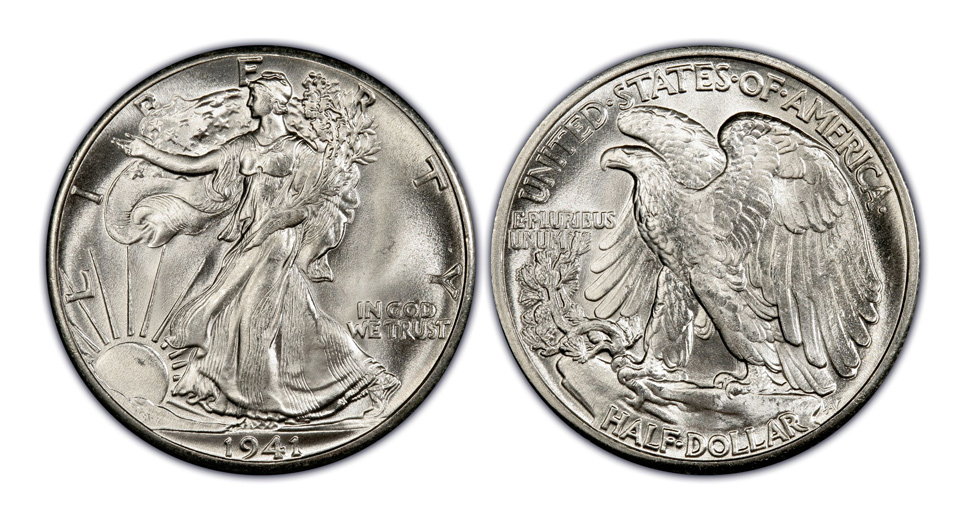
Walking-Liberty-Half-Dollar-Uncirculated The year was 1916, and America was a nation in ferment. It was a time of transition: from horse and buggy to horseless carriage … farms to cities … domestic tranquility to foreign entanglement … peace to war.
Major changes were taking place in United States coinage, too. Within the previous decade, exciting new designs had debuted on six different U.S. coins, supplanting the serene, sedate 19th-century portraits that preceded them. And now, in 1916, three more old-style coins—the Barber silver coins—were heading for the sidelines as well.

Outside artists not on the staff of the U.S. Mint had furnished new designs for the six previous changes, and Mint Director Robert W. Woolley showed his satisfaction by going outside again. In 1915, he invited three noted sculptors—Hermon A. MacNeil, Albin Polasek and Adolph A. Weinman, all of New York City—to prepare designs for the three silver coins, apparently with the intention of awarding a different coin to each artist.

The Mint may not have planned it this way, but Weinman ended up getting two of the three coins, the dime and half dollar, with MacNeil getting the quarter and Polasek being shut out. It’s hard to imagine how Polasek or anyone else could have improved on the winning entries, though, for all three of the new coins—the Mercury dime, Standing Liberty quarter and Walking Liberty half dollar—are magnificent coinage artworks.
A. A. Weinman was born in Germany but came to the United States at the age of ten in 1880. He honed his skills as a student of the famed Augustus Saint-Gaudens and, by 1915, he was widely acclaimed as one of the nation’s finest sculptors.

For the obverse of his design, Weinman chose a full-length figure of Liberty striding toward the dawn of a new day, clad in the Stars and Stripes and carrying branches of laurel and oak symbolizing civil and military glory. The reverse depicts a majestic eagle perched on a mountain crag, wings unfolded in a pose suggesting power, with a sapling of mountain pine—symbolic of America—springing from a rift in the rock. These strongly patriotic themes resonated perfectly across a nation then preparing to enter World War I, ironically against the land of Weinman’s birth. Weinman placed his initials (AW) directly under the eagle’s tail feathers.

Unlike the other two Barber coins, the Barber half dollar wasn’t produced in 1916. Even so, the Mint delayed release of the new Walking Liberty coin until late November. It drew immediate praise. The New York Sun, for instance, pronounced it a “lively” coin, typifying “hustle,” while the Boston Herald said it had a “forward look on its face.”

First-year coins from the branch mints in Denver and San Francisco carry the “D” or “S” mintmark on the obverse, below IN GOD WE TRUST, as do some pieces minted the following year. Partway through production in 1917, the mintmarks’ location was moved to the lower left of the reverse, just below the sapling, and that’s where it remained until the series ended in 1947.
Over 485 million Walking Liberty halves were made between 1916 and 1947, but they were issued only sporadically during the 1920s and early ‘30s, none being minted in 1922, 1924-26 and 1930-32. These were coins with substantial buying power, enough to buy a loaf of bread, a quart of milk and a dozen eggs in the early ‘30s, so it didn’t take huge quantities to fill Americans’ needs, especially after the Wall Street crash plunged the nation into the Great Depression.

Mintages were particularly low in 1921, and the P, D and S half dollars from that year all rank among the major keys of the series. Other scarce issues include the 1916, 1916-S, 1917-D and S (with the mintmarks on the obverse) and 1938-D. Brilliant proofs were minted from 1936 to 1942, totaling 74,400 pieces, and a very few satin-finish proofs were struck in 1916 and ‘17.

ussbunkerhill


“Walkers,” as they’re frequently called, are large, precious metal coins with a much-admired design. As a result, they hold great appeal not only for traditional hobbyists but also for non-collectors. Many exist in grades up to Mint State-65. Even above that level, significant numbers exist for certain dates, particularly the later years. Most dates, however, come weakly struck, particularly on Liberty’s left hand and leg, head and skirt lines and on the eagle’s breast and leg feathers. Sharply struck coins often command substantial premiums. In an attempt to improve the striking characteristics of the design, some minor modifications were made by Chief Engraver George T. Morgan in 1918 and 1921 and again by Assistant Engraver John R. Sinnock in 1937 and 1938. None of the revisions seemed to help, as even later issues are often weak in the central parts of the design. Places to check for wear include Liberty’s head, breast, arms and left leg and the breast, leg and forward wing of the eagle.

A full set consists of 65 different date-and-mint combinations but is attempted and completed by many collectors. Although Walkers were not saved in any quantity by the public, particularly in the Depression years, professional numismatists like Wayte Raymond and others put away many early rolls during the ‘30s. Uncirculated specimens of certain dates in the 1910s and ‘20s are probably only available today due to the foresight of these astute dealers. Later-date Walkers also have a strong following: many collectors assemble “short sets” from 1934 to 1947 or 1941 to ‘47. Type collectors just seek a single, high-grade example.

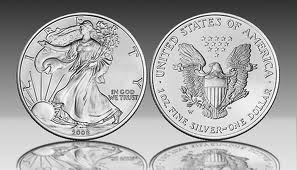
The Franklin half dollar succeeded the Walker in 1948. But 38 years later, in 1986, Uncle Sam dusted off the Weinman design for the obverse of the one ounce American Eagle silver bullion coin, which has been minted annually ever since.
January 28, 2013

U.S. Mint Runs Out Of American Eagle Silver Coins, Suspends Sales

NEW YORK (Reuters) – U.S. Mint has suspended sales of its 2013 American Eagle silver bullion coins after running out of stock due to soaring investor demand for the newly minted coins in the first two weeks of the year.eagle

Sales to authorized dealers will resume on or about the week of Jan. 28 after the U.S. Mint has replenished its inventory, it said in an email to authorized dealers on Thursday. The coins are produced at the Mint’s West Point, New York, facility.

While it is typical for collectors to snap up newly stamped coins, interest this year has ballooned due to investors seeking refuge from U.S. economic uncertainty.

Silver Eagle sales to Jan. 15 exceeded 5 million ounces and were on track to surpass the all-time monthly high of 6.1 million ounces, set in January 2012.

Physical coin sales had risen in the final months of 2012 as investors protected their nest eggs from a feared U.S. recession. Many economists predicted a U.S. economic downturn would occur if Congress and the White House did not act to stop pending huge tax hikes and automatic spending cuts known as the “fiscal cliff.”

It is not the first time the Mint has faced a run on its stock. It started allocating sales to authorized dealers in recent years after its supplies were depleted by unprecedented demand.

The Mint had been due to start taking orders for coins, which fetch just under $63 each, from the general public on Jan. 24.

January 14, 2013

Debt Ceiling: Selling Gold Isn’t the Answer

130109050127-gold-bars-monster

CNNMoney

The idea of minting a $1 trillion platinum coin as a way to avoid the U.S. debt ceiling is officially off the table.

But what about selling the nation’s deep gold reserves?

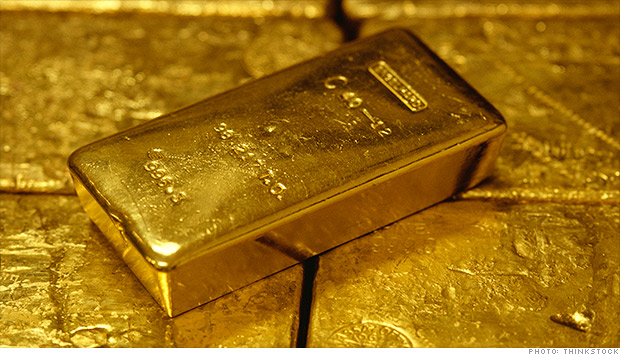
After all, the U.S. Treasury has 261.5 million ounces of the precious metal in Fort Knox, Kentucky. With gold selling at roughly $1,655 an ounce, the government has $432 billion worth of the shiny metal just collecting dust.

But even before anyone succumbs to the temptation of suggesting the gold option, U.S. Treasury Secretary Tim Geithner has nixed the idea. The optics of the U.S. holding a fire sale of assets such as gold would damage the country’s reputation and have global implications, he said.

“Selling the nation’s gold to meet payment obligations would undercut confidence in the United States both here and abroad, and would be extremely destabilizing to the world financial system,” he wrote in a letter to Congressional leadership last month.

President Obama also chimed in at a press conference on Monday, saying there are “no magic tricks” or “easy outs” to the debt challenge.

It would certainly buy Washington more time at a time when lawmakers can’t seem to agree on anything. There are only two months left for politicians to debate over the terms under which they raise the debt ceiling, and the

U.S. has already reached its legal borrowing limit.

Selling the gold could serve as an additional revenue stream without running up any more debt, which would relieve pressure on Congress to come to a consensus by March.

But experts say getting rid of the Treasury’s gold won’t work for many reasons.

The first is that though the sale would generate upwards of $400 billion, it would barely make a dent in paying the nation’s bills. The government currently borrows about $100 billion each month, meaning that the sale would only cover the U.S.’ debt obligations for about four months.

“At its best, it would just be a temporary stopgap,” said Chris Blasi, president of Neptune Global Holdings, a boutique precious metals firm in Wilmington, Del. “If you really wanted to solve our problems long-term, this is not a solution.”
Another problem: gold prices are bound to crash if the U.S. Treasury were to flood the market. That would reduce how much the government could collect.

“There would be a glut of metal coming in to the market, which would cause prices to pull back,” said Blasi. He said prices could retreat immediately by about 12%.

A larger issue is the signal it would telegraph to the world financial markets that the U.S. is getting desperate.

“Confidence would plummet and it would really hasten the demise of the dollar,” he said. “If you get down to a point where you’re hocking your gold, that’s it. You’re all done.”

Related: Debt ceiling: Welcome to Fight Club

These drawbacks haven’t stopped people from suggesting this as a viable solution in the past. The same idea was kicked around last year when Washington slogged through debt ceiling negotiations in the summer of 2011.

The British did it more than a decade ago. Former Prime Minister Gordon Brown sold off nearly two thirds of the United Kingdom’s gold, or nearly 13 million ounces between 1999 and 2002. Brown, who was the nation’s chief finance minister at the time, believed he was getting rid of a useless asset.

But his timing was off; the sale happened before one of the biggest bull runs in gold prices. The metal, at the time, was selling at near-record lows of an inflation-adjusted average of $275 an ounce.

The sales amounted to about $3.5 billion. Today, the sale would have been worth about six times more.

“When Britain did it, it was just a ridiculous move, selling off reserves at the complete bottom,” Blasi said. “But the ramifications would be far greater if the U.S. did it … We’d be admitting to the world that we’re willing to sell whatever we have.” To top of page

November 30, 2012

SS Brother Jonathan

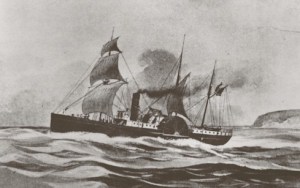
bro6Brother Jonathan was a paddle steamer that crashed on an uncharted rock near Point St. George, off the coast of Crescent City, California, on 30 July 1865. The ship was carrying 244 passengers and crew with a large shipment of gold. Only 19 survived the wreck, making it the deadliest shipwreck up to that time on the Pacific Coast of the United States. Although accounts vary, inspection of the passenger and crew list supports the number of 244 passenger and crew lost with 19 people surviving. She was named after Brother Jonathan, a character personifying the United States before the creation of Uncle Sam.
Vanderbilt’s company had had an exclusive contract ferrying passengers across the isthmus through Nicaragua, but in 1856, the Nicaraguan government canceled the agreement. The ship was then sold to Captain John Wright, whereupon she was renamed Commodore and put on West Coast routes, including from her home port of San Francisco to Vancouver, British Columbia, as gold prospectors traveled to the Fraser Canyon Gold Rush.
The ship played a small but symbolic role in the history of the state of Oregon. After President James Buchanan signed the bill admitting Oregon to the Union on 14 February 1859, the news was wired to St. Louis, carried by stagecoach to San Francisco, and loaded on Commodore on March 10. On March 15, the ship docked in Portland, delivering the official notification of statehood to the people of Oregon.
By 1861, she had fallen into disrepair and was sold again to the California Steam Navigation Company, who retrofitted her, restored her original name of Brother Jonathan, and continued her on the northward route from San Francisco to Vancouver via Portland, allowing prospectors to work the Salmon River Gold Rush. Over the next several years, the vessel gained a reputation as being one of the finest steamers on the Pacific Coast, being the fastest ship to make the run, sixty-nine hours each way.
bro5
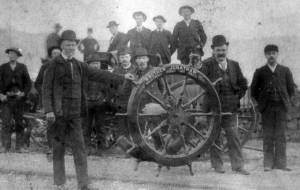
On her last voyage, the ship ran into a heavy gale within hours after leaving San Francisco harbor and steaming north. Most of the passengers on board Brother Jonathan became seasick and were confined to their rooms by the continuing storm of “frightful winds and stormy seas”. Early Sunday morning, July 30, 1865, the steamer anchored in Crescent City harbor on the first leg of its trip to Portland and Victoria, B.C. After leaving the safety of the bay that Sunday afternoon, the ship ran headfirst into more stormy conditions. The seas were so bad near the California-Oregon border that the captain ordered the ship turned around for the safety of Crescent City. Forty-five minutes later on that return and close to port, the ship struck the rock, tearing a large hole in its hull. Within five minutes, the captain realized the ship was going to sink and ordered the passengers and crew to abandon ship. Despite having enough lifeboats to hold all of the people on board, only three were able to be deployed. Acts of courage and desperation, fear and self-sacrifice, were numerous. The rough waves capsized the first one that was lowered and smashed the second against the vessel’s sides. Only a single surfboat, holding eleven crew members, five women and three children managed to escape the wreck and make it safely to Crescent City.Among the victims were Brigadier General George Wright, the Union Commander of the Department of the Pacific; Dr. Anson G. Henry, Surveyor General of the Washington Territory, who was also Abraham Lincoln’s physician and closest friend; James Nisbet, a well-known publisher, who wrote a love note and his will while awaiting his death; and Roseanna Keenan, a colorful San Francisco madam, who was traveling with seven “soiled doves”. As a result of this tragedy, new laws were written to increase passenger-ship safety, including the ability of lifeboats to be released from a sinking ship.
For its final voyage, crates of gold coins had been loaded on the vessel, including the annual treaty payments in gold for Indian tribes, Wells Fargo shipments consigned for Portland and Vancouver, and gold carried on board by the passengers. A large ship’s safe safeguarded valuable jewelry, more gold coins, and gold bars. The gold alone was valued at $50 million dollars in today’s dollars. Divers and ships began searching for the sunken treasure two weeks after the disaster, but despite the attempts of numerous salvors, for over 125 years, the ship’s treasure of gold and artifacts remained one of the Pacific’s great secrets.
Despite the fact that Brother Jonathan sank so tantalizingly close to shore, the ferocious storms, rocky passageways, strong underwater currents, and darkness at the depths held the secret of her location. Although the ship sunk 8 miles (13 km) from Crescent City, technology needed to improve and explorers had to change their assumptions before the ship could be found. On the last day of its 1993 expedition, Deep Sea Research (DSR) changed its theory. The men decided that the ship had actually floated underneath the ocean’s surface to finally hit bottom 2 miles (3.2 km) from where it first smashed into the reef. Led by Donald Knight and under risky conditions, a mini-sub on October 1, 1993, discovered the ship there at the last minute. Over time, the team began to bring artifacts back from a depth of 275 feet (84 m).
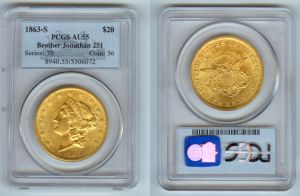
No human remains were ever found. In 1996, a mini-sub scooted past a “glint” on the bottom, raising curiosity. On August 30, 1996, divers found gold coins and on that expedition recovered 875 1860s gold coins in near-mint condition. Over time, the salvers recovered 1,207 gold coins, primarily $20 Double Eagles, in addition to numerous artifacts.
Thousands of items eventually were brought up, ranging from 19th-century cut-crystal sherry glasses, white porcelain plates, beer mugs, and terracotta containers (once holding mineral water from Germany) to exquisite glassware, cups, glass containers, and multi-faceted cruet bottles. Wine and champagne bottles, crates of goods (from axe handles to doorknobs), tinctures of medicine, port holes—among many goods and objects—were discovered.bro4
While recovery efforts were being conducted, the lawsuits flew around among the salvers, the State of California, and numismatic experts. California took the legal position that it owned the rights to the wreck and everything located close to its shores. As the state had enacted a broad law granting it these rights to “historical shipwrecks”, it fought the salver’s claims of ownership. Although every judge along the way disagreed with California’s position, a number of states with similar interests joined in the legal battle. Finally, the U.S. Supreme Court in 1998 unanimously held that existing federal law controlled, declared the law(s) unconstitutional, and ruled for the salvors.  However, California officials told DSR that they would take the fight up again to the Supreme Court on the facts, and the state received 20% of the recovered gold in a final settlement.
In the first legally-recognized sale of all of the salvors’ gold discovered from a sunken treasure ship, more than 500 bidders crowded into the Airport Marriott Hotel in Los Angeles for the auction of DSR’s gold coins on May 29, 1999. The sale of its 1006 coins fetched a total of $5.3 million. Later, the finders of the coins once again appealed the Supreme Court’s decision and were granted the rest of California gold coins.
Meanwhile, another battle had broken out over the authenticity of historic gold bars secretly recovered from Brother Jonathan in the 1930s. Reading like a “Who’s who” in numismatic circles, these experts viciously attacked each other over these bars in a rare public controversy (the “Great Debate”) at the 1999 American Numismatic Association’s annual convention—a battle that still resounds among collectors and gold experts. This also resulted in litigation.
DSR set up a conservation lab for the recovered artifacts that was run by the local historical society in Crescent City, the Del Norte County Historical Society. The salvors also hired national experts including numismatists Robert R. Johnson, Ronald F. Umile, and Konstantin Balter to work with the volunteers in these efforts. This small historical society has been refurbishing and maintaining the artifacts, as well as having an exhibit on Brother Jonathan’s demise and a variety of the objects that were reclaimed.bro2
The reef the ship slammed into is now known as Jonathan Rock, and the St. George Reef Lighthouse was built in response to this disaster. A memorial for the deceased, registered as California Historical Landmark #541, sits at Brother Jonathan Vista Point in Crescent City. The shipwreck is listed in the National Register of Historic Places.Despite the gold coins already discovered and brought up, crates of gold from Brother Jonathan still remain hidden and undisturbed. The large safe with its millions of dollars of jewels, gold bars, and gold was never found. The salvors estimate that 4⁄5ths of the treasure is still waiting to be discovered—mere miles from land. In 2010, folk music singer/songwriter John Donovan released an album entitled Bells Will Ring, a line from his song about the shipwreck entitled “Brother Jonathan.”

bro3

September 4, 2012

Bechtler Gold

During the Colonial Era gold in North Carolina was only found in trace amounts.  It wasn’t until the year 1799 that substantial success was achieved, by accident, in Cabarrus County.  The first substantial piece was found by twelve year old Conrad Reed who was fishing in Meadow Creek with his brother and sister.  He withdrew from the small stream a shiny yellow substance that he assumed to be some type of metal.  He brought the nugget home to his father, John Reed, who upon examination declared it as an unknown metal and put it to use as a door stop for two years.  In 1802 he took the nugget to a jeweler in town who immediately recognized the “metal” and its value.  The jeweler converted the nugget into a gold bar measuring roughly 8 inches long and asked Mr. Reed if he would sell it.  Mr. Reed, not knowing the value of the gold bar, sold it to the jeweler for $3.50.  In time Mr. Reed found several pieces of gold along the creek bed and in 1803 he found a piece weighing in at twenty-eight pounds.  The creek was rich in gold and in the year 1831 the veins of the mine were discovered.  In 1848 a sketch of the mine was made by a miner, Colonel George Barnhardt, and he declared the Reed Gold Mine to be the first in the United States.

Meanwhile in 1825 several mines were opened within a twenty mile radius of Charlotte.  Two of the more significant mines were the Rudisill Mine of Count Ravafanoli, which brought experienced miners from Italy and other parts of Europe and the St. Catherine Mine opened by Samual McComb.  These two mines were the most profitable with assays ranging from $24.80 to $72.41 per ton.  Being rich in ore, the Rudisill mine was still in operation by the end of the Civil War.

It soon became essential that the miners have a local facility for processing the substantial quantities of gold flowing through North Carolina.  Unfortunately the U.S. Mint was opposed to the idea and it was several years before a branch mint was established; this delay provided and excellent opportunity for private minters.

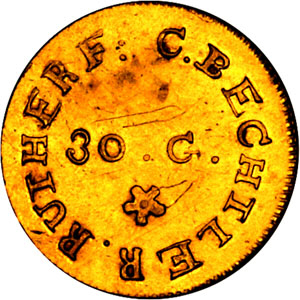
In 1829 German born Christopher Bechtler, Sr.,  arrived in New York City with his son August and his nephew, Christopher.  A year later they bought a tract of land in Rutherford County establishing themselves in the local community as jewelers and watchmakers.  In 1831 the miners’ plight brought enough business to the Bechtler’s that it resulted in a private mint and assay office.  The Bechtler mint cast dies for $2.50 and $5.00 pieces.  The coins were noted for being 20 carats fine, or 2 carats below the US standard.  Bechtler coinage of 1831 bore the words “South Carolina” and “gold”.  Coins appearing later than 1834 bore the words “North Carolina Gold”, “Carolina Gold”, and “Georgia Gold”.  Bechtler soon had a reputation as a “man of competent science and skill to assay and bring the gold of the mines to a standard value, in the form of coin…he is a man of the strictest honesty and singleness of purpose.”  His popularity and reputation allowed for almost ten years of coinage.

Value Coined
January, 1831 thru December, 1834        $109,732.50
January, 1835 thru December, 1835        $695,896.00
January, 1836 thru August, 1836        $471,322.50
September, 1836 thru May 1838        $770,329.50
June, 1838 thru February, 1840        $194,560.00
$2,241,840.50

Bechtler, Sr. operated the mint until his death in 1842 and was succeeded by his son August who was later succeeded by his nephew Christopher.  Unfortunately neither August or Christopher had the pristine reputation of Sr., as their coins were often underweight or of dubious fineness.

Bechtler gold coins were minted eight years before the first striking at the new federally established mints in Chalotte, NC & Dahlonega, GA in 1838. They were so well accepted for commerce that they became a standard for currency in the south.  During the Civil War the monetary obligations of the Confederacy were specified as payable in “Bechtler gold” rather than Union, Confederate, or State currency.

Today, Bechtler coins are rare and command high prices, especially those minted prior to the Coinage Act of 1834 which increased the value of gold by more than six percent which resulted in a massive melting of gold coins, Bechtler’s included. They are considered the crown jewels of any southern mint type set.


August 3, 2012

Why Warren Buffett May Be Wrong On Gold

CNN Money

by Paul La Monica

Warren Buffett is one of the world’s most famous and successful investors. You have to take almost anything he says seriously. But his loathing for gold? That’s another story.

The Berkshire Hathaway chairman and CEO has had some inspired rants against the yellow metal. Buffett most recently addressed the topic in his annual letter to shareholders in February.

A choice gem? He noted that if you owned 170,000 tons of gold now, 100 years later that cube of gold “will be unchanged in size and still incapable of producing anything. You can fondle the cube, but it will not respond.”

Buffett prefers stocks over gold and other commodities because public companies own assets that make tangible things. These companies also often pay dividends — especially the more conservative, mature companies that Berkshire tends to own. In other words, stocks are productive assets. Gold is not.

But what if Buffett is wrong? Have you noticed what gold has been doing lately? The metal is once again above $1600 an ounce and back in positive territory for the year. Sure, goldis still about 15% below last year’s all time high of near $1925 an ounce. And gold has lagged the stock market in 2012… even with the recent rally.

But gold has been on a bull run that has outpaced stocks for more than a decade. It’s not, to use a gold metaphor, a flash in the pan. Some think gold will soon outshine stocks once again.

With the Federal Reserve and European Central Bank both meeting later this week, many investors are betting that the Fed and ECB will at least open the door for more stimulus if not necessarily announce new easing plans.

Anything that Ben Bernanke and Mario Draghi do or say that is interpreted as a sign that they will soon be willing to flood the markets again with more liquidity would likely be good for gold. Loose monetary policy tends to be bad news for currencies, in this case the dollar and the euro. And since gold is often considered an alternative currency as much as it is a commodity, more easing should drive gold higher.

“If gold goes higher in the short-term, it will be because the Fed and ECB stepped on the gas,” said Jeffrey Nichols, senior economic advisor to Rosland Capital in New York. Nichols, a gold bull, said he thinks more easing is in the cards for an extended period of time considering how weak the global economy is. As such, he thinks gold could be back at record highs later this year or sometime in 2013.

But what about Buffett? If the Oracle of Omaha is advising people to steer clear of gold, should investors really dismiss that? Actually, yes.

Steven Feldman, CEO of Gold Bullion International, a firm that allows people to invest directly in the physical metal, said that he’d love to debate Buffett about the merits of gold. Feldman, who used to be a partner at Goldman Sachs, says there is a misunderstanding about gold among novice and sophisticated investors.

Feldman said the anti-gold mantra is somewhat of a unique phenomenon. Both individual investors and central banks in emerging markets like India and China have traditionally been more inclined to view gold as a safe haven investment. Do the math. If a lot of people in China and India want to keep buying gold, the price of the metal is likely to go up … no matter what we Americans think.

“In the U.S., we are very much in love with our house, stocks and bonds. But that is a very American-centric investing approach not shared around the world,” Feldman said. He added that the simple laws of supply and demand make gold a compelling investment. Supply is limited and it is often tough to extract, adding to the scarcity value.

Feldman also quipped that there appears to be no “fracking” equivalent for gold, i.e. technology that will make it easier to mine, like there is for oil and gas in the energy industry.

So it seems there is a good short-term case (Fed and ECB easing/currency devaluation fears) and long-term case (demographics/Economy 101) for gold. Does that mean you should rush out and put all your money into the metal? Of course not. It’s just as reckless to overload on gold as it would be to have all your savings in your house, a bond fund or shares of the company that you work for.

Nichols said that for most investors, having 5% to 10% of their portfolio in gold is probably enough. And both Nichols and Feldman said that buying gold bullion coins also is the most sensible thing to do because you then have that hard asset.

“People that spend their lives looking at stocks and bonds think gold is this barbaric metal,” said Jeff Sica, president and chief investment officer of SICA Wealth Management in Morristown, N.J. “Gold getting the respect of Wall Street? That’s never going to happen. It’s always going to be under constant scrutiny.”

Nonetheless, Sica thinks gold is likely to top $2000 an ounce sometime before the year is over. And he isn’t worried about what Warren Buffett thinks about gold. Neither should you.

June 4, 2012

Estate tax increase: Forgotten fiscal cliff issue

NEW YORK (CNNMoney) — The estate tax was here. Then it was gone. Now it’s back. And it’s about to become much bigger next year.


The estate tax is one of the many pieces of the so-called fiscal cliff facing the country at year’s end. That’s when $7 trillion worth of tax hikes and spending cuts are set to take effect unless Congress decides otherwise.

The estate tax is paid by a relatively small number of families who inherit wealth, but it has always played an outsize role in the political debate over taxes.And it has traveled a torturous path.

 Since 2001, the amount of money exempt from the estate tax has been set at six different levels and the top rate has been adjusted nine times, according to the American Bar Association.

Rules also changed — then changed back again — on how to value inherited assets, and on the gift tax.  Those are just a few examples of how Congress kept moving the goal posts.

Tiny but powerful: The estate tax lobby; Estate planning lawyers aren’t optimistic that lawmakers will reform their ways any time soon.

 “Oh, no. I’m not at all confident we’ll have something certain going forward,” said Steve Hartnett, associate director of education at the American Academy of Estate Planning Attorneys.

 This year, estates under $5 million are exempt from the tax. Amounts above that are taxed up to a top rate of 35%. (See how many Americans have at least $2 million in wealth.)

 Next year, barring congressional action, the exemption level falls to $1 million, and the top rate jumps to 55%. There will also be 5% surtax on a portion of very large taxable estates.

 That suits some liberals just fine. But Mitt Romney, along with many conservatives, wants to repeal the estate tax altogether. If that doesn’t fly, conservatives would at least like to preserve the current $5 million exemption level at 35%.

 President Obama wants to split the difference: an exemption level of $3.5 million and a top rate of 45%. Those were the levels in 2009. Whichever option lawmakers ultimately choose, the estate tax’s reach would remain narrow.

 This year, under the $5 million exemption level, less than 0.2% of those who die — or 3,600 estates — are likely to be affected by the estate tax, according to estimates from the independent Tax Policy Center.

 In 2013, if the exemption level falls to $1 million, the Center estimates that just 2% of folks who die that year — or 53,000 estates — would be subject to the estate tax. Combined, the tax on those estates could raise more than $40 billion.

 Were Congress to adopt Obama’s proposal, roughly 7,500 estates would be affected in 2013, which would raise roughly $22 billion.

 What’s the fuss? A tax on the transfer of wealth at death has been on the books in one form or another since 1797, according to the Joint Committee on Taxation.

 Initially, the tax was a way to raise revenue for warfare. But by the early 20th century, it was intended to break up large concentrations of wealth among the very few.

 Today, those who support having an estate tax also warn about high concentrations of wealth and about the need to raise revenue at a time of high deficits.

April 10, 2012

What are Retail Prices?

 Jeff Garrett for NGC 1/20/2011

When NGC asked me to write a column on coin pricing for their new price guide, my immediate reaction was “this should be easy.” After giving the project some thought, I realize how complex the subject is. As everyone knows, there are at least a dozen published price guides for rare coins. Some are done yearly, such as the Guide Book of United States Coins (Redbook), while others are done monthly, weekly or in real time. The goal of each is to report the most accurate reflection of the retail rare coin market. Even what constitutes “retail prices” can be a matter of debate, however. Many would argue that auction prices are retail, while others view these as dealer prices. Some in the numismatic community think retail prices should be about 5% above what dealers have paid; others believe a 35 to 40% market is more in line. My plan is to examine this issue in great detail so that when making a purchase and using the NGC Coin Price Guide, you will have a clear understanding of how the numismatic marketplace works.

 The goal of the NGC Coin Price Guide is to provide the most accurate and up-to-date tools for collectors and dealers to establish current retail pricing for United States coinage. The NGC Coin Price Guide is just one element available on the NGC site for information. Others include the NGC Census , which shows the population of coins that have been certified, the NGC Coin Encyclopedia, NGC Registry information and the recently developed charting capabilities for each issue. With this wealth of information, rare coin collectors will now have the ability to research and make important buying decisions. An educated buyer will do much better in the long run than someone who makes rash, uninformed purchases. Paying too much can mean waiting years longer just to break even on a poorly executed buy. I encourage everyone to explore the new NGC Coin Price Guide and all of the other great research tools available at NGCcoin.com.

What is retail?

 There is no short answer for this question. As mentioned above, some think auction prices are retail. This is not true in most cases. Rare coin dealers purchase a large percentage of coins at every auction held in the United States. You can be sure they are not buying the coins for their personal collections. On the opposite extreme, when two wealthy collectors engage in mortal combat for a prized registry coin, the hammer price is not the new retail price for this coin. Also, a coin that falls through the cracks, selling for well below catalogue levels, is not the new retail price. As will be examined in detail in later installments, not every coin in the same grade looks the same. If two NGC MS 65 1907 High Relief Double Eagles are sold in the same auction and one brings $42,500 and the other brings $48,000, which is the new retail price? Sometimes the price difference can be even greater. Auction prices are an indication of value — not a retail price. Price guide editors must use auction records for information, but other factors come into play as well.

 Retail price can best be defined as the price a collector can expect to pay for a coin after conducting moderate research. An example would be generic United States gold coins. These are very common and with moderate research a buyer should expect to pay 5 to 10% above dealer wholesale price to acquire an example. Finding a very rare coin is another matter. It may take years to find and negotiate the purchase of an extremely rare coin. The dealer will probably ask for a market — up closer to 40% in this case. As a collector myself, I can testify that when you locate something you have been looking years for, price is sometimes secondary.

February 29, 2012

Last & Largest California Gold Rush Nugget

The LARGEST CALIFORNIA GOLD RUSH NUGGET left in existence, the 100 troy ounce gold nugget discovered last year in Nevada County, California, was sold at auction on March 16th in Sacramento for $460,000

Named the “Washington Nugget” because the nugget was discovered near the famous northern Mother lode Gold Rush mining camp of Washington, California, this nearly 100 ounce monster gold nugget (and several others) were found in an unmined section of the Omega-Malakoff Tertiary Channel in February 2010, by a lucky area land-owner.

Authenticated by geologist Fred Holabird and pre-sale valued at $250,000-$400,000, the nugget is the largest, original California Gold Rush region natural nugget still in existence.

Spectrum Numismatics came away with the nugget on Wednesday after a feverish two minutes of bidding at the Golden West Auction in Sacramento. The company was bidding on behalf of an anonymous buyer.

At current gold prices, the nugget’s gold value was just less than $138,000, but auctioneers say its connection to the 19th century Gold Rush helped boost the final hammer price.

The auctioneer said the person who found the nugget also plans to auction the 180 acres where it was discovered.

February 15, 2012

States seek currencies made of silver and gold

NEW YORK (CNNMoney) — A growing number of states are seeking shiny new currencies made of silver and gold.

Worried that the Federal Reserve and the U.S. dollar are on the brink of collapse, lawmakers from 13 states, including Minnesota, Tennessee, Iowa, South Carolina and Georgia, are seeking approval from their state governments to either issue their own alternative currency or explore it as an option. Just three years ago, only three states had similar proposals in place.

“In the event of hyperinflation, depression, or other economic calamity related to the breakdown of the Federal Reserve System … the State’s governmental finances and private economy will be thrown into chaos,” said North Carolina Republican Representative Glen Bradley in a currency bill he introduced last year.

Unlike individual communities, which are allowed to create their own currency — as long as it is easily distinguishable from U.S. dollars — the Constitution bans states from printing their own paper money or issuing their own currency. But it allows the states to make “gold and silver Coin a Tender in Payment of Debts.”

To the state legislators who are proposing state-issued currencies, that means gold and silver are fair game, said Edwin Vieira, an alternative currency proponent and attorney specializing in Constitutional law. And since gold has grown exponentially more valuable, while the U.S. dollar continues to lose ground, the notion has become increasingly appealing to state lawmakers, he said.

The state gold rush: Utah became the first state to introduce its own alternative currency when Governor Gary Herbert signed a bill into law last March that recognized gold and silver coins issued by the U.S. Mint as an acceptable form of payment. Under the law, the coins — which include American Gold and Silver Eagles — are treated the same as U.S. dollars for tax purposes, eliminating capital gains taxes.

Since the face value of some U.S.-minted gold and silver coins — like the one-ounce, $50 American Gold Eagle coin — is so much less than the metal value (one ounce of gold is now worth more than $1,700), the new law allows the coins to be exchanged at their market value, based on weight and fineness.

Local currencies: In the U.S., we don’t trust

“A Utah citizen, for example, could contract with another to sell his car for 10 one-ounce gold coins (approximately $17,000), or an independent contractor could arrange to be compensated in gold coins,” said Rich Danker, a project director at the American Principles Project, a conservative public policy group in Washington, D.C.

South Carolina Republican Representative Mike Pitts proposed a currency system that would allow people to use any kind of silver or gold coin — whether it’s a Philippine Peso or a South African Krugerrand — based on weight and fineness. Pitts said in the bill, which currently has 12 co-sponsors, that the state is facing “an economic crisis of severe magnitude.”

Republican representatives from Washington State followed suit in January, introducing a bill that would also allow any gold and silver coins to be considered legal tender based on metal values. Minnesota, Iowa, Georgia, Idaho and Indiana are also considering similar proposals.

Many of the bills would make it possible for residents to exchange the physical coins for goods and services, so you could use coins to buy anything from groceries to a car as long as the store chooses to accept them.

However, most people aren’t going to walk around with such valuable coins in their pockets, said Vieira. Plus, calculating the value of the coins — especially if they come from different parts of the globe and are of different sizes and shapes — will get tricky.

It’s more likely that the states will create electronic depositories and accounts for the coins to make transactions easier, when and if the initial bills are passed, he said.

Utah Gold & Silver Depository is already developing a system where customers could use debit cards linked to their gold holdings. When customers swipe their debit cards to make transactions, physical gold and silver coins would be transferred between accounts in privately-owned depositories (or vaults) based on the market value of the metals.

Before deciding on a specific form of currency, some states — including Minnesota, Tennessee, Virginia and North Carolina — are considering proposals that would first require a committee to review their alternative currency plan.

The future of U.S. currency: The states’ proposals have been gaining steam among Tea Partyers and Republicans, many of whom also endorse a nationwide return to the gold standard, which would require the U.S. dollar to be backed by gold reserves.

Tea Party “father” Ron Paul is sponsoring the “Free Competition in Currency Act,” which would allow states to introduce their own currencies, and rival Newt Gingrich is calling for a commission to look at how the country can get back to the gold standard.

But it will be the individual states that could really get the ball rolling, said Vieira. Even if several of the current proposals get killed, the introduction of so many bills at the state level is drawing national attention to the issue, he said.

Funny money: 11 local currencies

Of all the state proposals circulating right now, Republican-controlled states including South Carolina, Georgia, Idaho and Indiana have the best chance of passing their proposed bills this year, said American Principles Project’s Danker. If just one or two states implement an alternative currency, it could have a Domino effect, he said.

“I think we could get a couple passed in this legislative session, and that would show this is mainstream, popular and it would be a justification for more of the risk-averse states for doing this,” he said.

There are, of course, many people who think the recent push for alternative state currencies should be stopped in its tracks. David Parsley, a professor of economics and finance at Vanderbilt University, said he thinks state-issued currencies are a “terrible” idea.

“Having 50 Feds” could debase the U.S. dollar and even potentially lead the country into default, he said. “The single currency in the United States is working just fine,” said Parsley. “I have no idea why anyone would want to destroy something so successful — unless they actually wanted to destroy the country.” To top of page