January 12, 2012

Record Sale

Chicago Sun Times

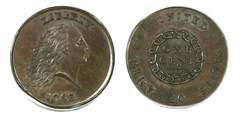
An uncirculated one-cent copper coin from the earliest days of the U.S. Mint in 1793 has sold for a record $1.38 million at a Florida auction. The sale price was “the most a United States copper coin has ever sold for at auction,” says James Halperin of Texas-based Heritage Auctions.

The coin was made at the Mint in Philadelphia in 1793 — the first year that the United States made its own coins. The name of the buyer wasn’t revealed.

The penny shows no wear on its lettering, its Lady Liberty face or the chain of linking rings on its back. It’s known as a “Chain Cent” because its chain of linking rings was supposed to represent the solidarity of the states. The design was changed to a wreath after some critics claimed it was symbolic of slavery.

January 12, 2012

Starting Off With A Bang


     The first major coin show of the year, the Florida United Numismatists (FUN) Show, was by all accounts a resounding success.  With over $56 million sold at auction 2012 is looking like it will be another strong year for rare coins.

     Of particular note is what kind of material was NOT available at FUN and why: high end coins (those priced from $10,000 to $50,000) were very scarce.  Given that these coins have been in demand for several years it can only mean we are going to see higher prices offered in an effort to pry them from what are clearly tight hands. Additionally, when those prices rise, it is almost a certainty that their less expensive brethren will see an increase, too.

December 15, 2011

250 Million To Be Dumped Into High End Rare Coins

$250 Million Rare Coin Fund

yahoo News

A new joint venture has been launched by a team that includes a veteran professional rare coin dealer and a Wall Street money manager to assist investors with acquisition and management of numismatic and precious metals items. 

“The investment community has a need for alternative investments that are truly uncorrelated with traditional investments. Using rare coins as an asset class and investment vehicle provides an opportunity for investors to diversify their investment portfolios. We plan to have a diversified family of investment funds and services to be able to address alternative investments and financing needs, from the private investor to even institutional investors.”

 A source with knowledge of the strategies who asked for anonymity, said one of the funds is expected to reach $250 million comprised primarily of U.S. coins certified by either Professional Coin Grading Service or Numismatic Guaranty Corporation

 The custodian of the partnership assets initially will be First State Depository Company, a level three, high security facility in Delaware that stores precious metals and rare coins for investment banks, brokerage firms, refining companies, commodity trading houses, precious metals retailers, coin dealers and individual investors.

December 15, 2011

Gold’s Recent Drop Is A Buying Opportunity; We’ll Still See $2,000+ An Ounce In 2012

Kerri Shannon; ETF Dailey News

 If you’re concerned about where gold prices are headed after yesterday’s (Wednesday’s) bear-market buzz, don’t be. This is just a brief pit-stop in what continues to be an epic bull-run for the yellow metal.

Gold prices fell below $1,600 an ounce Wednesday for the first time since October, settling down nearly 5% at $1,586.90 an ounce Comex division of the New York Mercantile Exchange (NYMEX). That’s below the closely-watched 200-day moving average for the first time since January.

There are a few reasons for this slump: Panic over the Eurozone and its weakening currency, banks’ need for cash, and year-end profit-taking have all taken their toll on gold this week.

Still, while gold prices may be stumbling right now, they are not headed for a long-term bear market – not even close. In fact, it’s something our own gold and global resources specialist predicted months ago.

Money Morning Global Resources Specialist Peter Krauth said as far back as August that gold prices were due for a pull-back, so this minor blip isn’t surprising – and it definitely isn’t permanent.

“This is something I saw coming,” said Krauth. “Back in late August, as gold was pushing $1,900, I told my subscribers it was due to pull back, and likely to trade in a range between $1,600 and $1,800, and that’s exactly what we’ve seen so far. We could see a bit more weakness, but I think we’re much closer to a bottom at this point.”

Here’s why.

A Weak Euro and the Scramble for Cash

One of the biggest factors contributing to lower gold prices is the Eurozone and its increasingly weak currency. The euro fell Wednesday to $1.2998 against the dollar, its lowest level since January. That forced many traders into the dollar.

“As investors flee the euro, the “risk off’ trade means they’re falling back on the U.S. dollar,” said Krauth. “A higher U.S. dollar, in turn, means lower gold because gold is priced in U.S. dollars.”

Krauth said Europe’s economic turmoil has forced the region’s banks to hunt for more cash, which has led to more gold leasing transactions, further pressuring the precious metal’s price.

“European commercial banks are desperate for cash,” said Krauth. “They could well be “borrowing’ central bank or other sourced gold to lend out simply to raise cash temporarily. Interestingly, gold lease rates just spiked back up on Dec. 7, the very same day we started that recent bout of gold price weakness.”

Investors’ year-end scramble to get their hands on more cash also has triggered massive selling. After poor portfolio performance this year, investors and fund managers wanted to take profits and beef up cash holdings, while others needed cash to make margin calls.

According to a recent Reuters asset allocation poll, global portfolio managers held more cash in November than at any time during at least the last seven years.

“[S]ome macro hedge funds are liquidating gold holdings and taking profits in a difficult year,” HSBC Holdings analyst James Steel wrote in a note. “As trading volume typically drops toward year-end, we expect increasingly volatile price swings.”

Other factors weighing on gold include the U.S. Federal Reserve’s lack of commitment to help the weak U.S. economy and the fallout of the MF Global Holdings  bankruptcy.

“The bankruptcy led to the liquidation of many gold futures contracts where positions needed to be unwound,” said Krauth.

But as Krauth said, this price tumble does not seal the deal for a long-term gold bear market.

Where Gold Prices Are Headed

Gold has soared 175% since its price rally begin in 2009, and is still up 88% despite this year’s price volatility and recent dip.

Krauth maintains his outlook that it will soar well over $2,000 an ounce next year — and keep going.

“I believe gold prices will eclipse $2,200 an ounce next year, and shoot beyond even $5,000 an ounce after that,” said Krauth.

That means more buying opportunities as prices pull back temporarily.

“If you are a commodities investor, there will be some great opportunities over the next couple of months to accumulate again if you’re looking further ahead,” Ole Hansen, senior manager at Saxo Bank, told Reuters. “The super-cycle is nowhere near dead, but right now, it is a question of getting exposure down and coming back in two weeks and seeing where we are.”

Bespoke Investment Group tracked gold’s previous slips below the 200-day moving average, and found it more often turned around to higher prices.

“While gold saw negative returns in the three, six, and twelve months following the end of its 1980 and 1988 streaks, following the four remaining streaks the close below the 200-DMA turned out to be a pause that refreshed for gold,” Bespoke wrote in a report released Wednesday.

November 17, 2011

Back on The Gold Standard? $17,821 Gold?

Its All About Gold Now

by Greg Hunter

At the beginning of this month, the G20 met in France to try to find a way to solve the European sovereign debt crisis.  It ended with world leaders in disarray over a way to come up with a solution.  At first blush, it appears that nothing of any importance came of the meeting of the 20 leading economies of the world, but that is not the case.  It was widely reported the G20 came up with the idea that Germany might put up its gold reserves to back a bailout fund called the European Financial Stability Facility or EFSF.  Of course, Germany, with its more than 3,400 tonnes of gold (number 2 in the world), quickly shot that idea down.  End of story?  Quite the contrary–the gold story is just beginning to get interesting.

You see, the G20 did something accidentally that was very important, and that was confirm that gold has a place in the monetary system, especially in times of extreme turmoil.  Why doesn’t the EU use sovereign bonds to back the EFSF?  They are considered a store of value and are held as reserves in many European banks.  The simple answer is the world is waking up to the fact that debt can’t back up debt.  Europe finds itself in a tough spot, and the leaders there know it.  Reuters reported Monday, German Chancellor Angela Merkel said, “Europe is in one of its toughest, perhaps the toughest hour since World War Two,” she told her Christian Democrats, saying she feared Europe would fail if the euro failed and vowing to do anything to stop this from happening.”  Well, anything but put Germany’s gold up as collateral.  Maybe Chancellor Merkel will be the next leader to exit the European stage?  Who knows, but what I do know is that gold is once again going to become an important part of the world monetary system.

In a new book called “Currency Wars,” Wall Street insider Jim Rickards examines how countries try to get out of financial trouble by devaluing their currencies.  Rickards says, “Today, as yesterday, countries are attempting to devalue their way out of trouble. Following the strategy of beggar-thy- neighbor, the U.S., Europe, China and Japan all want to weaken their currencies. The flaw in the tactic should be clear. “Not everyone could cheapen at once,” Rickards writes. “The circle still could not be squared.” Rickards predicts the U.S. dollar’s future is not bright, and if there were a “catastrophic collapse of investor confidence,” the dollar’s buying power could suffer suddenly and dramatically in a global sell off.

Gold would be the big beneficiary if the dollar declined, and Rickards’ top price for gold per ounce is–wait for it–$44,552!   That price is the absolute highest possibility.  Rickards and others predict that in the next few years, America will go back on some sort of gold standard.  Meaning, the dollar will be backed by gold, but Rickards has stated on many occasions that there probably will not be a100% gold backed U.S. dollar.  Instead, Rickards contends it will be more in the neighborhood of 40%.  If that is the case, then gold would be $17,821 per ounce using Rickards numbers.  It appears gold prices are going much higher.

https://i0.wp.com/ecx.images-amazon.com/images/I/51bRiqkKYKL._SS500_.jpg In a new book called “Currency Wars,” Wall Street insider Jim Rickards examines how countries try to get out of financial trouble by devaluing their currencies.  Rickards says, “Today, as yesterday, countries are attempting to devalue their way out of trouble. Following the strategy of beggar-thy- neighbor, the U.S., Europe, China and Japan all want to weaken their currencies. The flaw in the tactic should be clear. “Not everyone could cheapen at once,” Rickards writes. “The circle still could not be squared.”Rickards predicts the U.S. dollar’s future is not bright, and if there were a “catastrophic collapse of investor confidence,” the dollar’s buying power could suffer suddenly and dramatically in a global sell off.

Gold would be the big beneficiary if the dollar declined, and Rickards’ top price for gold per ounce iswait for it–$44,552!   That price is the absolute highest possibility.  Rickards and others predict that in the next few years, America will go back on some sort of gold standard.  Meaning, the dollar will be backed by gold, but Rickards has stated on many occasions that there probably will not be a100% gold backed U.S. dollar.  Instead, Rickards contends it will be more in the neighborhood of 40%.  If that is the case, then gold would be $17,821 per ounce using Rickards numbers.  It appears gold prices are going much higher.

The main factor in determining gold price is money printing, and one of the biggest currency creators on the planet is the Federal Reserve.  It created enormous amounts of money in the wake of the 2008 meltdown, and it looks like it is getting ready to unleash mountains of even more cash to stop the impending Euro-land meltdown.  This week, St. Louis Fed President James Bullard indicated the central bank would take action if the EU sovereign debt crisis turns chaotic.  According to a Wall Street Journal report, “Bullard said that if overseas events worsened significantly, the Fed could respond, saying “the Fed can re-open some of the liquidity facilities that were used during 2008-2009″ to reduce related market disruptions. “It will be fairly clear if some sort of crisis occurs in financial market that causes trust to break down,” it would then be time for the Fed to take action to alleviate the market tumult, he said.”   It looks to me the Fed will be forced to print money to stop another financial meltdown.  It is only a matter of time, and time appears short.

Renowned economist Martin Armstrong says, “What this is really about is it’s the entire Western civilization that’s starting to crumble.”  In an interview Monday on King World News, Armstrong warned, “Everything is falling apart and the politicians will not address it because it means having to change the system and that’s what they do not want to do.  The real big money that I speak to, they are really starting to look beyond Italy, Greece, Spain and Portugal.  They are starting to look at France and Germany.”  Armstrong goes on to say, “They have borrowed year after year with no intention of paying it back.  The US had $1 trillion of debt when Ronald Reagan took office in 1980.  We are now pressing $15 trillion of debt.”  The debt crisis throughout the Western world will push the price of the yellow metal higher even though it is currently range bound.  Armstrong says, “Basically what you are doing is you are building a sideways type of base.  Eventually gold is going to take off to the upside, but largely when people begin to see the Emperor has no clothes and we’re getting close to that.  I would only give it a few more months.”

When the next financial calamity hits, the Fed and other central banks will have two choices.  They can print money to try and save the system they love, or let it implode.  That means this is really all about gold now.

November 3, 2011

Gold: The Hedge Against Political Stupidity

NEW YORK (CNNMoney) — Gold is said to be a hedge against inflation, deflation and all other nasty sorts of economic bugaboos. It looks like it may be a hedge against political incompetence too.

The price of gold has surged more than 7% in just the past week and a half. The yellow metal is now trading around $1,750 an ounce.

That’s still a bit lower from the all-time high of about $1,924 from just a few months ago. But experts think that a new record could be in the cards soon if the debt melodrama in Europe (As George Papandreou Turns?) continues.

The incessant chatter and gossip — will there be a referendum or not? — is only serving to make already jittery investors even more skittish. That’s a perfect recipe for a rally in gold, which is the quintessential safe haven because it’s something with tangible value … as opposed to a stock or paper currency.

“What’s driving gold right now is that investors don’t know what to do. All the rumors in Europe are making people worried,” said David Beahm, vice president of economic research with Blanchard & Company Inc, a New Orleans-based investing firm that specializes in gold and other precious metals.

“Gold may be volatile but I can’t see a reason why it would go down much. I think a price of $2,000 by the end of the year is still possible,” Beahm added.

But it’s not just the latest EU scuttlebutt that is lifting gold. Actual news is helping too. In somewhat of a surprise move, new European Central Bank president Mario Draghi announced that the ECB was cutting interest rates.

That could put more pressure on the Federal Reserve, which did not announce any new policy moves after its meeting Wednesday, to do something if the global economy continues to founder.

Greece goes all in

The Fed can’t cut rates (they’re already at zero) but some are urging the central bank to start a third round of bond buying, a so-called QE3. In fact, one Fed member, Chicago Fed president Charles Evans, dissented with the central bank’s decision to stand pat. According to the Fed statement, Evans wanted “additional policy accommodation at this time” — which is likely code for QE3.

If Evans eventually gets his way, more bond purchases would probably suppress the value of the dollar as investors would once again worry that the Fed is just printing money. And that would create inflation fears which would lead to even higher gold prices. Gold traders are also likely feasting on bullish comments from influential hedge fund manager David Einhorn on Tuesday.

During a conference call to discuss the results of Greenlight Capital Re, the insurer that Einhorn is chairman of, Einhorn gushed about how well he thought gold miners would perform. He said his firm has shifted some money into the Market Vectors Gold Miners, adding that he expected gold prices to continue to rise.

Einhorn is a big enough name that what he says could become a self-fulfilling prophecy. Just ask any investor who was caught with a long position in Green Mountain Coffee Roasters, which has plunged more than 30 % since Einhorn said he was shorting it a few weeks ago.

Commodity bears aren’t going anywhere

Still, any investor rushing into gold now has to be extremely careful. Rob Stein, senior portfolio manager with Astor Asset Management in Chicago, said that gold definitely could hit $2,000 before long. But he also thinks the bubble may eventually burst. We’ve seen that movie before several times. It never ends well.

Gold will probably remain attractive as long as Europe, and to a lesser extent the U.S., remains in economic crisis mode. But this too shall pass. It may not be for a couple of years, but Stein said gold prices can’t remain this high forever. Enjoy it while you can.

“Economic growth will eventually hurt gold,” Stein said. “If we get to 2013 and the Fed finally starts raising rates like it says it will, you’ll see gold head back down. I could easily see it falling to $1,000.”

Then again, 2013 is a long time away. And even if Greece and Europe finally get their act together, investors can then turn to the folly that is Washington, DC. Would it be any surprise to see gold move higher this year once the deficit supercommittee talks start to steal headlines from the EU?

The opinions expressed in this commentary are solely those of Paul R. La Monica. Other than Time Warner, the parent of CNNMoney, and Abbott Laboratories, La Monica does not own positions in any individual stocks

October 27, 2011

FRESH & RARE COINS IN DEMAND GOLD 10% OVER PLATINUM

GreysheetThe rare coin market remains on solid ground after the metals gyrate, with individuals continuing to buy, seeking an alternative to other investments and as a hedge against future inflation. Established collectors are carrying on with their endeavors, but continue meeting some headwinds as it gets more difficult to locate the coins they want and/or as selective prices climb higher. Still, strong prices are being paid to acquire better quality coins, especially CAC approved material, which can be sold sight-unseen for all the premium and no hassle of returns or any of the other obstacles to rapid liquidation. Better date Morgans are particularly hot this week in this regard.
Coin shop activity continues on the buying side with the public still bringing in coins, jewelry, and precious metals to sell with some in a panic as metal prices have plunged during recent weeks. More sophisticated collectors, however, are continuing to hold, but some are liquidating to cover losses in other areas. Gold has remained above the $1,600 per ounce mark lately, currently at $1,656, recovering from a recent decline to $1,593 September 26. For the last two weeks, Platinum has traded below Gold, and is now hovering around 10% lower than the yellow metal, while Palladium has dropped to below $600 which hasn’t taken place since late October of last year.
This is an off week for some dealers who only attend the major shows, a welcome break from the busy August and September schedule of the ANA, Long Beach, and Whitman Philadelphia shows. Other dealers are already in the area of Pittsburgh for the Fall National Money Show beginning October 13, attending a pre show in nearby Monroeville, PA, which runs through October 10. Several smaller shows are filling in the gaps around the country for some collectors and dealers who would normally attend the major shows. However, some of these smaller one-day shows used to be two, or even three-day events, but have shrunk during the past decade or two because of increased internet trading and the slow coin market that occurred prior to the bull market of the 2000s. Many of the dealers who set up at the smaller shows are shop dealers who have been buying from the public and have precious metal related products and less expensive coins the average collector is seeking; whereas the major shows have a larger presence of national dealers who serve high-end collectors and investors with a different inventory make-up.
ICTA, the Industry Council for Tangible Assets, has been receiving calls about stepped up enforcement of local and state Secondhand Dealer laws which require dealers to hold items such as scrap jewelry, flatware, precious metals, bullion coins, and sometimes even high-priced rare coins and currency. Increased appearances by hotel buyers, and other itinerant buyers, are a concern to policing authorities, as are established coin shops and offices. Many dealers are surprised to learn that their cities and states have laws already on the books that are now increasingly being enforced. Most of these laws require dealers to hold this merchandise from usually 7 all the way up to 30 days.

October 27, 2011

Gold Back In Favour – Probes $1720 – More Upside Seen.


With Europe teetering on a knife edge gold has once again resumed its role as the custodian of safe – and perhaps sane wealth. Gold prices firmed throughout late New York trading yesterday where it breached the $1700 level. The firm tone prevailed during Asian trading hours this morning, when gold traded to a high of $1719.80 before easing slightly. Behind the move higher has been a surge in purchases of gold ETFs as well as ongoing strong demand for physical bars. The ETFs have seen 16.5 tonnes of new gold buying over the last 2 days which is driving gold higher. It will be interesting to see if the futures traders on COMEX reverse their recent thinking by following suit and drive this market significantly higher.

The speed and nature of the gold price rise seems to suggest to us that gold is back to its old self again and behaving in the manner one might expect, with equities off as gold rallied.  That is to say it is rallying during bouts of heightened economic crisis. The VIX Index is modestly firmer underscoring market concerns, while more worrying Italian 10 year bonds are nudging the 6% level (Greece received its initial bail-out when theirs breached 7% – currently at 25%).

In short – gold is back.

The financial markets are giving a very clear signal. They are saying that they doubt that the 27 EU nations will reach an accord on policies to resolve sovereign debt while stimulating economic growth. The market is looking for “specifics” and not “generalities”. There is a sense that we have heard too much talk and we need clear, cogent and do-able proposals.

At stake is the potential collapse of the Euro and therefore Europe – it’s as simple as that. As such gold which has been behaving more like a risk asset, has reverted to its safe haven role and showed appropriate gains.  Whilst inflation may not be with us at present investors clearly believe it may only be a matter of time. Gold investors clearly recognize that the potential for inflation is now with us and they are buying the physical… put another way, they know that its a bit too late to start buying house insurance after there is the clearest smell of smoke in the air.    

I don’t think any sane person would relish the meltdown of the EU (with its untold consequences) but many will see the current inability of political leaders to gain consensus and support for what may become unpopular political decisions to be endemic to the sort of structure that has been created. That is to say a fragmented decision making process by unelected leaders when these times call for quite the opposite. As such, it is falling to Merkel and Sarkozy to lead the way.

With such epic economic and geo-political themes at play, each with with unknown consequences it is difficult to make forecasts. But the uncertainty that this is creating is almost certain to be gold-friendly and we scope for gold to continue making strong gains from here. As such, we would see the next $100 in gold to be to the upside rather than than the downside. 


September 27, 2011

Gold Will stay Glittery

gold prices

NEW YORK (CNNMoney) — Gold officially lost its status as a safe haven last Friday, when the precious metal inked its sharpest drop since 1980.

The recent sell-off in gold prices moved the yellow metal below $1,600 an ounce, a roughly 15% drop over two weeks.

Several traders and industry watchers say gold’s sharp correction was largely due to hedge fund and other money managers amping up their cash holdings in anticipation that investors may start asking for cash back, raising the threat of a flood of redemption requests.

“Whenever you have a market correct as quickly as gold just did, you can assume people are gettingmargin calls,” said Wayne Atwell, managing director at Rodman & Renshaw, who covers the precious metals market.

Since much of the pullback came from money managers selling gold for more cash, analysts and investors say gold will remain volatile but the price shouldn’t fall much farther.

Big hedge funds are getting slaughtered

Although money managers have been selling large swaths of gold, retail investors don’t appear to be looting their gold holdings.

Exchange traded funds like SPDR Gold Shares (GOLD), iShares Gold Trust (IAU), ETFS Gold Trust (SGOL) and iShares Silver Trust (SLV) have not been selling into the broader market, according to Frank McGhee, head precious metals trader at Integrated Brokerage Services.

“To me, that’s one of those on the ground indicators that the run-up isn’t done, and people still want to hold gold,” said McGhee.

Indeed, the creation of these ETFs, which give retail investors easy access to precious metals, have been among the factors fueling gold’s sharp rise over the past decade.

Gold is still up over 95% from the beginning of 2007, when it traded near $800 an ounce. Meanwhile the S&P 500 is down 22% during the same time period.

Among the other reasons gold could retain its luster: central banks have become net buyers.

“Developing markets have been using gold as a way to diversify their holdings,” said Juan Carlos Artigas, investment research manager at the World Gold Council. “Many central banks had many of their foreign reserves based in U.S. dollar, so they had a lot of exposure to whatever is happening in the U.S.”

Whatever happens in Europe, it’s unlikely that the need to diversify holdings will abate, and gold is a relatively safe way for central banks to do this.

Copper prices are getting killed.

Where other metals, such as copper, have primarily industrial applications, gold can serve many masters. It can be used as a currency while also seeing demand from industrial products. (There are flecks of gold in Apple’s (AAPL, Fortune 500) iPhone.) Gold’s hybrid role gives investors more reasons to continue to buy the metal in up and down markets.

“You can walk into a bank anywhere in the world with gold and get any currency in the world,” said George Gero, a senior vice president at RBC Wealth Management. “Gold maintains its purchasing power, but this volatility is unprecedented.”

Even if gold continues to move up, analysts say that volatility — in all markets — is here to stay.  To top of page


September 23, 2011

Europe, Fed Actions Push Global Economy Towards Further Downturns

Following yet another barrage of negative information in the fragile U.S. economy the Fed has pledged to do whatever they can to get things moving again.  Their latest salvo, an attempt to lower long term interest rates, has given commodity bulls an opportunity to lock in profits and prepare for the next run up in prices.  The Fed hopes that by opening the money faucet they can avoid a prolonged deflationary period and kick start the economy.  Experts say that while there will be negative pressure on commodities in the short term that path that the Fed has taken will force those same commodities upward as inflation takes hold.  Additionally, the problems in several European countries, most notably Greece, have the potential to spread even more uncertainty into the U.S. economy. Rare coin investors seem to be the lucky group not sweating it out, rather, sighing in relief that their holdings aren’t shrinking in value.