July 15, 2016

Analyst: Silver Prices Could Triple

silver-prices

http://etfdailynews.com/2016/07/14/analyst-silver-prices-could-triple/

Respected metals and mining analyst John Embry wasn’t shy about his prediction for silver prices on Thursday, noting the precious metal could triple, quadruple, or even more in the coming months and years. Said Embry in an interview with KWN:

“…Silver is now performing more positively, despite the best efforts of the usual suspects to suppress the price. And this is confirmed by the Open Interest being near all-time record levels, which just shows how hard they are working to keep the price at low levels.

And the absolutely spectacular performance of silver mining equities so far this year tells the real story. I firmly believe we are on the cusp of an explosion in the silver price that will ultimately see silver trade at many multiples of the current $20 price (new all-time highs). And if the hyperinflation occurs, which I believe is inevitable due to the current global monetary policy, who knows how high the price can go?”

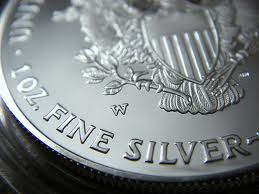
Such a move in silver wouldn’t be unprecedented. If you adjust for inflation, silver actually hit well over $100 back in 1979:silver-price-50-year-inflation-adjusted

June 24, 2016

Gold Races to 2-Year High As Investors Seek Refuge From Brexit

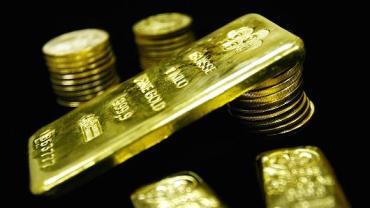
Gold soared as much as 8 percent to its highest in more than two years on Friday after Britain delivered a shock vote to leave the European Union, sending investors scurrying for protection in bullion and other assets perceived as lower risk.102382576-1717128.530x298

 In sterling terms, gold delivered double-digit percentage gains to top 1,000 pounds an ounce for the first time in more than three years, rallying as much as 21 percent in early trade, while euro-priced gold rose as much as 13 percent.

Spot gold peaked at $1,358.20 per ounce and was up 5.6 percent at $1,325.10 an ounce, while U.S. gold futures for August delivery were up $67.40 an ounce at $1,330.50 off an early high of $1,362.60 an ounce.

Shares of gold mining companies also rocketed higher, with a fund tracking the industry opening nearly 8 percent higher.

“(Brexit) benefits gold because in a general risk-off mode, it’s a natural safe haven for everybody,” Marie Owens Thomsen, chief economist at Indosuez Wealth Management, said.

“Now that the UK has voted to leave, we think there’s a higher probability that the $1,350-1,360 per ounce level can be breached, and we’re therefore looking for an extended target in the $1,400s.”

Gold priced in sterling was last at 965.80 pounds an ounce, up 14.5 percent, having peaked at 1,019.03 pounds overnight. Euro-denominated gold was up 9.5 percent at 1,195.20 euros an ounce, off a high of 1,244.34 euros.

Gold dealers in London reported surging demand for coins and bars among retail investors on Friday, with some saying stocks were tight.

Britain’s vote to leave the European Union forced the resignation of Prime Minister David Cameron and dealt the biggest blow to the European project of greater unity since World War Two.

World stocks headed for one the biggest slumps on record as the vote triggered 8 percent falls for Europe’s biggest bourses and a record plunge for sterling.

The single currency was under pressure as investors worried that the Brexit vote could encourage similar movements in other European countries.

U.S. short-term interest rates futures hit contract highs in early U.S. trading, boosting expectations the Federal Reserve may cut interest rates to help shield the economy from any global fallout.

“This isn’t necessarily about Britain, it’s about uncertainty in the world’s largest economy,” Amanda van Dyke, fund manager at Peterhouse Asset Management, said.

“The general commentators are suggesting that the Fed is no longer going to raise rates because the dollar is soaring, and they can no longer afford for the dollar to keep going as fast as it is.”

“Realistically, the ability of the European market to speak with a common voice I think has been permanently severed, and that’s going to be a solid 5 percent (price increase) in gold for at least the next couple of years.”

Silver futures were up 3.5 percent at $17.96 an ounce, while platinum futures were 3 percent higher at $994.60 an ounce.

June 2, 2016

May Gold Coin Sales Increase More Than 200% From Last Year

http://www.kitco.com/news/2016-06-01/May-Gold-Coin-Sales-Increase-More-Than-200-From-Last-Year.html

06012016NC_Coins_001

It’s a tale of two markets: gold futures ended May with the biggest monthly decline since November but physical demand saw a significant increase from last year.

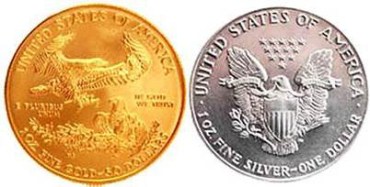
Sales data compiled by the U.S. Mint shows that a total of 95,000 ounces of gold were sold in May, up more than 206% from 31,000 ounces sold in May 2015.

Month-over-month sales was less impressive showing a 24% decline compared to a total of 125,000 ounces sold in April. Looking at the mint’s historical data, May is typically the start of slow season for the market; however, 2016 bucked the trend as this was the strongest May since 2011.

Silver demand was just as impressive as sales increased annually and month-over-month. The data showed that the U.S. Mint sold 4,489,500 ounces of silver in May, up 122% from 2,023,500 ounces sold in 2015, and up 10.5% from 4,072,000 ounces sold in April. This is the fifth consecutive month the mint has seen sales of more than 4 million ounces; in January of 2016, silver coin sales hit almost 6 million ounces.

George Gero, managing director with RBC Wealth Management, said that it is interesting to see the differences between the two markets. He explained that futures markets are weaker as short-term speculative investors slack their exposure to gold in the face of potential interest rate hikes. However, physical gold and silver buyers represent long-term investors.

“Looking at the physical markets you can see signs of long-term strength,” he said. “Coin buyers are going to be selling their physical gold any time soon.”

Phillip Streible, senior market strategist at RJOFutures, said that he is not surprised that investors are jumping into the bullion market. Global financial uncertainty and shaky equity markets makes gold and silver an attractive investment, he said.

“Physical buyers just don’t have any faith in the economy and the system and want a store of wealth they can trust,” he said.

May 19, 2016

We might be in the early stages of a gold ‘Super Spike’

http://www.businessinsider.com/we-might-be-in-the-early-stages-of-a-gold-super-spike-2016-5?utm_source=feedburner&utm_medium=referral

rocket-launch-innovation-3

Gold is a chameleon. It changes in response to the environment.

At times, gold behaves like a commodity. The gold price tracks the ups and downs of commodity indices.

At other times, gold is viewed as a safe haven investment. It competes with stocks and bonds for investor attention.

And on occasion, gold assumes its role as the most stable long-term form of money the world has ever known.

A real chameleon changes color based on the background on which it rests. When sitting on a dark green leaf, the chameleon appears dark green to hide from predators. When the chameleon hops from the leaf to a tree trunk, it will change from green to brown to maintain its defenses.

Gold also changes its nature depending on the background.

Golden Chameleonrtx10d70
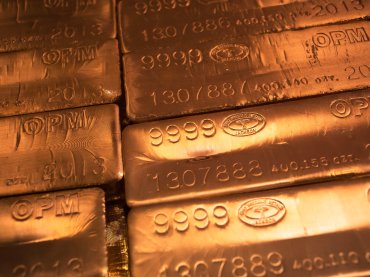
Right now, gold is behaving more like money than a commodity or investment. It is competing with central bank fiat money for asset allocations by global investors. That’s a big deal because it shows that citizens around the world are starting to lose confidence in other forms of money, such as dollars, yuan, yen, euros, and sterling.

This is great news for those with price exposure to gold. The price of gold in many currencies is going up as confidence in those other currencies goes down. Confidence in currencies is dropping because investors are losing confidence in the central banks that print them.

For the first time since 2008, it looks like central banks are losing control of the global financial system. Gold does not have a central bank. Gold always inspires confidence because it is scarce, tested by time, and has no credit risk.

Gold’s role as money is difficult for investors to grasp. One criticism of gold is that is has no yield. Gold has no yield because money has no yield. In order to get yield, you have to take risk.

Bank deposits, and so-called money market funds, have yield, but they are not money. A bank deposit is subject to default by the bank, as we saw recently in Greece and Cyprus. A money market fund is subject to collapse of the fund itself, as we saw in 2008.

Gold does not have these risks.

Lost confidence in fiat money starts slowly then builds rapidly to a crescendo. The end result is panic buying of gold and a price super spike.

We saw this behavior in the late 1970s. Gold moved from $35 per ounce in August 1971 to $800 per ounce in January 1980.

That’s a 2,200% gain in less than nine years.

A “Super Spike” in Gold

We may be looking at the early stages of a similar super spike that could take gold to $10,000 per ounce or higher. When that happens, there will be one important difference between the new super spike and what happened in 1980.

Back then, you could buy gold at $100, $200, or $500 per ounce and enjoy the ride. In the new super spike, you may not be able to get any gold at all. You’ll be watching the price go up on TV but unable to buy any for yourself.

Gold will be in such short supply that only the central banks, giant hedge funds, and billionaires will be able to get their hands on any. The mint and your local dealer will be sold out. That physical scarcity will make the price super spike even more extreme than in 1980.

screen shot 2016-05-16 at 11.00.01 amscreen shot 2016-05-16 at 11.00.13 am

The time to buy gold is now, before the price spikes and before supplies dry up.

What signs do we see that gold is now behaving like money?

For one thing, gold price action has diverged from the price action of other commodities. This divergence first appeared in late 2014 but has become more pronounced in recent months.

Gold observers know that gold measured in dollars is down significantly from its all-time high in 2011. COMEX gold peaked at $1,876 per ounce on Sept. 2, 2011. And recently traded as low as $1,056 per ounce on Nov. 27, 2015. That’s a 44% decline in just over four years. Yet in the same time period, broad-based commodities indices fell even more. One major commodities index fell 53%.

The contrast between the behavior of gold and commodities is even more extreme when we narrow the time period. From June 20, 2014 to Jan. 15, 2016, the broad-based commodity index fell 63%, while gold fell only 17%. The recent collapse in commodity prices was almost four times greater than the decline in gold prices.

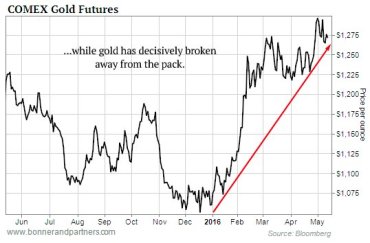
From mid-January to mid-February 2016, gold rallied 14% while commodities still languished near five-year lows.

The Monetary System Is Going Wobbly

Right now, investors around the world are losing confidence in Chinese yuan, Saudi rials, South African rand, Russian rubles, and a long list of other emerging market currencies. Investor preferences are shifting toward gold. This accounts for gold’s outperformance of the rest of the commodity complex when measured in dollars.

What is interesting is that when the price of gold is measured not in dollars but in rubles, yuan, or rials, the percentage price increase in gold increases as currencies decline against the dollar.

When you understand that gold is money and competes with other forms of money in a jumble of cross rates with no anchor, you’ll know why the monetary system is going wobbly.

It’s important to take off your dollar blinders to see that the dollar is just one form of money. And not necessarily the best for all investors in all circumstances. Gold is a strong competitor in the horse race among various forms of money.

Normally, I recommend a 10% allocation of investable assets to physical gold for your permanent portfolio. But when short-term trading opportunities arise, certain gold trades, such as exchange traded funds (ETFs), are a great way to get dollar price exposure to gold and book 100% or more profits.

This chameleon has changed color recently. And the new color is gold.

May 13, 2016

Classic Cars, Rare Coins Top Knight Frank’s Luxury Index

http://www.cnbc.com/2016/05/13/classic-cars-rare-coins-top-knight-franks-luxury-index.html

http://video.cnbc.com/gallery/?video=3000517505

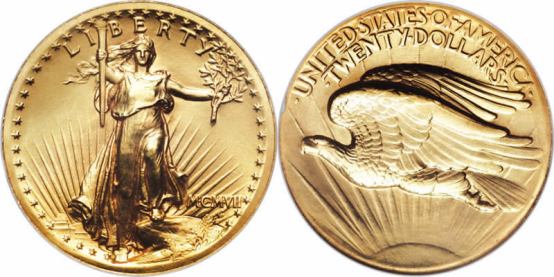
Classic cars and rare coins maintained their status as the world’s best-performing luxury assets in 2015 thanks to stellar auction results, according to a new report.

103633000-soth.530x298

The Knight Frank Luxury Investment Index (KFLII), which tracks the performance of a theoretical basket of selected collectable asset classes using existing third-party indexes, said the value of the world’s most collectible vehicles increased 17 percent on-year.

“Eight of the 25 cars ever to have sold for over $10 million at auction all went under the hammer in 2015. These included all-time high results for Porsche ($10.1 million) and McLaren ($13.75 million),” Knight Frank said. Jaguar’s C-Type Works Lightweight, sold in August, commanded a cool $13.2 million.

But investors need to keep an eye out for potholes ahead. Growth in 2015 was lower than the previous year’s 25 percent expansion, the report noted.

“The collector market is reacting to a downturn in global liquidity and potential interest rate rises,” the report stated, citing research firm Historic Automobile Group International (HAGI). HAGI publishes an index on rare collector’s automobiles that Knight Frank used for its KFLII.

1907-st-gaudens-double-eagle-high-relief-wire-rim

Rare coins meanwhile recorded a 13 percent rise last year, higher than 2014’s 10 percent expansion.

The value of rare coins exchanging hands in the U.S. alone was worth between $4-5 billion last year, estimated Stanley Gibbons Investment (SGI), the firm behind the Stanley Gibbons 200 Index that Knight Frank referenced.

Investment-grade coins typically boast the potential to appreciate in value irrespective of what’s happening in financial or precious metal markets, SGI explains on its website.

Among the notable items sold last year was a 2,000-year old gold Aureus coin that went for £300,000 ($433,185).

Just earlier this month, a penny coin dating back to 1933—one of only four ever made—was sold for £72,000 ($103,951), the world record amount for a copper or bronze coin ever sold at auction.

Watches and wine were the next best assets, logging a 5 percent spike each, followed by a 4 percent rise each for jewelry and art.

Both contemporary and modern art underpinned gains in the latter group, with notable sales such as Picasso’s Women of Algiers setting an all-time auction high of $179 million in May.

Wine meanwhile is beginning to see a recovery, as fine Bordeaux models start stabilizing following a slump induced by dropping Chinese demand.

Chinese ceramics and colored diamonds posted zero growth for the year while antique furniture registered the worst performances on the KFLII, falling 6 percent.

Overall, the KFLII expanded 7 percent in 2015 following last year’s 6 percent growth. In comparison, the FTSE 100 equity index fell 5 percent while the top end of London’s residential property market grew only 1 percent.

May 10, 2016

Coin Collecting – How Long Should You Hold Your Collection?

http://www.coinweek.com/dealers-companies/ngc-dealers-companies/coin-collecting/

Being in a rush when buying or selling coins will lead to poor results.

One of the most frequently asked questions I receive from collectors is about how long to hold before selling. This seems like a simple question, but the answer can be much more involved. Nearly all collectors pursue numismatics because they enjoy it, but most are also concerned about the investment aspect as well.

How long you are willing to hold your coins is a major element in being a successful collector.

collectors_old_time

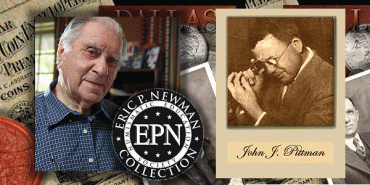
Over the years I have seen every type of collector when it comes to how long they hold coins. On one extreme there are the collectors who never sell. That will be a decision for their heirs when they pass. John Jay Pittman was a great example of this. He collected coins for decades starting in the 1940s. He never sold coins to travel the world, buy fancy cars, or build his dream home. He may have traded a few coins over the years, but for the most part his collection remained intact until he died in 1996. He truly loved his coins, but upon his death, his heirs auctioned the collection for over $30 million almost immediately.

The famed collector Eric P. Newman also played the long game, accumulating most of his fabulous collection in the 1930s, ’40s and ’50s. He decided to sell and donate most of the proceeds to charities of his choosing. Not a bad strategy, but most collectors won’t celebrate their 100th birthday like Eric did a few years ago! His collection earned over $55 million when certified by NGC and sold by Heritage from 2013-2014.

For obvious reasons, holding coins for 40-50 years is almost always a great investment. Most collectors however, have a much shorter time horizon.

On the other end of the spectrum I have had customers who bought coins with an extreme case of ADD (attention deficit disorder). One week they want to buy every coin in a series and a short time later move on to something else. They love the hunt, but when done or facing a few holes in the collection that are difficult to fill, they are ready to move on. This is usually a terrible way to buy coins. Most retail collectors who buy rare coins have to pay at least 10-30% above wholesale to acquire them. This spread is hard to overcome when selling too soon.

The concept can be understood by examining recent auction records for coins purchased from old time collections, and then resold at auction less than 24 months later. The 1828 Quarter, now graded NGC MS 67, that Newman purchased in the 1940s for $50 is a great example.

For most collectors, a holding period of at least 5-10 years is recommended for the best performance. In fact, this amount of time is usually required to form a nice collection of most series. Finding the right coin at the right price is critical if you hope to be a successful collector/investor. As I have preached many times in my articles, numismatic education and patience are very important.

Patience is also required for many collectors who choose out of favor and underpriced areas of the market. For decades tokens, medals, and many non-traditional numismatic items sold for a pittance in relation to their importance. The sale of the John Jay Ford collection by Stack’s Bowers changed that forever. His collection, that contained very few examples of Federal coinage, sold for over $35 million in a series of blockbuster auction sales.

World coins are another example of patience being an incredible asset. Twenty-five years ago, many Chinese coins were practically free. With the development of the Chinese economy, these coins have soared in value and desirability.

Many parts of the United States coin market have been flat for decades. This includes most Type coins, silver and gold commemoratives and many others. Someday these will also have their day, but in the meantime collectors will need patience. Selling too soon can be painful.

In summary, building a well thought out collection of coins or paper money takes lots of time and patience. For the best performance, wait until the area of the market you have chosen to collect has its day in the sun. Being in a rush when buying or selling will lead to poor results. In my opinion, buying and selling with a short time horizon is more about speculation than collecting. Given enough time, most collectors will enjoy the journey and be well rewarded in the process.

May 5, 2016

The Chinese are on a massive gold shopping spree.

http://money.cnn.com/2016/02/10/investing/china-gold/

China’s government doesn’t share exact figures, but the vast majority of gold heading into mainland China passes through Hong Kong, which does make its records public.

Gold imports to China have surged over 700% since 2010, according to the latest data from Hong Kong.

Exactly what China is doing with all that gold remains somewhat of a mystery. The increasingly wealthy Chinese are buying, but that doesn’t explain all the jump in demand.

The government says its gold reserves have grown only a little in recent years. Experts question whether China is telling the whole truth.

“China has a lot more gold than they declare,” says John LaForge, head of Wells Fargo’s commodities team.

China’s big gold binge160209153154-chart-china-gold-780x439

China now consumes about 40% of the gold that comes out of the ground every year, according to LaForge.

The Hong Kong data alone show that China went from importing just over 100 tons of gold in 2010 to just under 1,000 tons last year.

In addition to all the imports, China is also the world’s largest gold miner, according to the World Gold Council. So it’s both buying and unearthing a lot of gold each year.

Who’s buying the gold?

Much of the gold going into China ends up in the hands of wealthy Chinese.

Citizens in one Chinese city actually attempted to construct a huge gold statue of Mao Zedong, the father of modern China, but the government tore it down in January.

From 1950 until 2004, private citizens in China were forbidden from owning gold. Now there’s huge demand for the shiny metal, according to an extensive report by the World Gold Council.

But the council concluded that gold imports “exceeded by some margin” the demand from people who want new rings and necklaces. The other big buyer is the Chinese government.

China was notoriously secretive about its government gold reserves. It reported 1,054 tons of gold in the spring of 2009.

It didn’t disclose its holdings again until 2015. Bloomberg Intelligence estimated that China’s government likely had over 3,500 tons of gold by then.

But the Chinese only reported about 1,700 tons.

“Next to oil, gold is probably the most important commodity in the world,” says LaForge. The Chinese “don’t want you to know what they’re doing with gold,” he added.

China now reports its gold holdings monthly because it was encouraged to do so by the International Monetary Fund.

In January, China said it had 1,778 tons in its reserves, a jump from December.

The People’s Bank of China has been taking extraordinary efforts to try to stabilize the value of the yuan. Buying gold helps increase confidence in the yuan’s worth. It’s also a way for China to diversify its reserves away from U.S. dollars.

Still, China lags the U.S. in gold reserves. The U.S. has by far the largest government reserve of gold in the world with over 8,000 tons.

May 3, 2016

This Rare Coin Just Sold for $2 Million

dimes

http://fortune.com/2016/01/08/rare-coin-auction/

Fortune.com


Talk about a return on investment.

If you were lucky enough to have gotten your hands on the rare 1894-S struck by the San Francisco mint during that year, you could have sold it today for a cool, 20 million percent return.

That’s right, at an auction run by Heritage Auctions in Tampa, Florida, the rare coin sold for $2 million, the company tells Fortune. The dime is prized by coin collectors for its rarity: there were only 24 ever minted, and only 9 are thought to still be in existence today.

David Hall, co-founder of Professional Coin Grading Service of Santa Ana, California, told ABC News, “A couple of coins have been known among the rarest of the rare for 100 years and this is one of those numismatic icons.”

Both the buyer and seller of the coin wish to remain anonymous, but a statement from Heritage refers to the buyer, who placed his bid online, as “an experienced collector.”

April 1, 2016

Gold’s Gain Is Biggest in Decades

BN-NI739_GOLD03_J_20160331155212

A worker tends a furnace filled with molten gold at a Congolese mine. Gold prices leapt 16% in the first three months of 2016. Photo: Simon Dawson/Bloomberg News By Ira Iosdbashvili

Wall Street Journal

http://www.wsj.com/articles/gold-posts-biggest-quarterly-gain-in-decades-1459463809

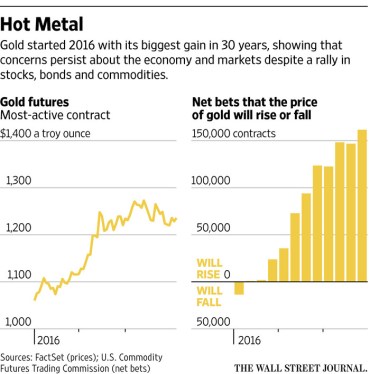
Gold prices notched their largest quarterly gain in three decades, showing that worries about the markets and economy continue despite a six-week-long rally in stocks, bonds and commodities.

Gold prices rose 16.5% in the first three months of the year, the biggest leap since 1986. Holdings at SPDR Gold Shares, the world’s largest gold-focused exchange-traded fund, are approaching their highest level since December 2013, while traders are placing more bets on rising prices.

The rally is a rare bit of good news for a metal that has been in retreat for much of the past five years, a period when U.S. economic activity picked up and the dollar surged. Even so, many investors remain skeptical that gold will go much higher unless the global outlook dims considerably.

“This is one of the most surprising gold rallies I have ever seen,” said Ira Epstein, a strategist at the Linn Group who has been trading gold for 40 years.

Net bets on higher gold prices by hedge funds and other speculative investors stood at 161,610 contracts in the week ending March 22, their highest level since February 2015, data from the Commodity Futures Trading Commission showed.

Jeffrey Gundlach, who runs Double Line Capital LP, said in January that gold could rise as high as $1,400 a troy ounce this year. He repeated the call again in March, but said he had become more nervous about the metal, given the magnitude of its recent rally.

Hedge-fund manager John Paulson pared his long-held bet on gold by $400 million in the fourth quarter of 2015, according to a 13F filing. A spokesman for Mr. Paulson didn’t comment.

Gold-mining stocks also have racked up big gains, although many have drifted off their earlier highs. Newmont Mining Corp is up 48% so far this year, Randgold Resources has gained 54% and Barrick Gold Corp the world’s largest gold miner by output, is up 72%.

A chunk of gold’s gains was concentrated in the first six weeks of 2016, when stocks, junk bonds and oil prices slumped, began to recover and then tumbled again. That isn’t unusual, because so-called haven assets like gold and ultrasafe government bonds tend to rise at times of market distress.


MI-CO957_GOLD_O_9U_20160331182706

But gold has held on to those gains even since the Dow industrials and other stock indexes posted a surge into the end of the quarter, a development that many investors view as signaling that the concerns that fueled the year’s early declines haven’t been fully resolved.

Chief among those: fears that central banks’ embrace of exotic policy, which deepened at the end of January with Japan’s decision to adopt negative interest rates, will further pressure economic growth and lead to market shocks such as the one that hit stocks and risky assets in February.

“People are reluctant to take profits on their gold positions because of all the insecurity the world is facing,” said George Gero, managing director at RBC Wealth Management.

To be sure, gold’s gains aren’t purely based on fear. Policy makers in Europe, China and the U.S. all signaled during the quarter that they expect interest rates to stay lower for longer, reflecting soft growth and below-target inflation. Lower rates tend to be associated with higher gold prices, because they lessen the advantage that yield-bearing instruments such as bonds and savings accounts carry in comparison with gold.

The Federal Reserve’s signals it will be slow to raise rates this year also led to a weakening of the dollar, a shift that tends to bolster the prices of commodities including gold that are priced in the U.S. currency.

Political uncertainty also has raised investor anxiety. Markets are also concerned about what a potential U.K. exit from the European Union would mean for European trade. In the U.S., the popularity of presidential hopefuls Donald Trump and Bernie Sanders raises questions about the future course of U.S. politics and policy.

February 19, 2016

1916

World War I was a watershed moment for America, a time when an isolationist nation involved itself in world affairs and began the rise to the economic and military power that America is today. After keeping out of the conflict that had been ravaging Europe for nearly three years, President Woodrow Wilson took America to war only months after winning an election on the slogan “He Kept us Out of War.” Claiming that American intervention was needed to “make the world safe for democracy,” Wilson sent over two million men to Europe, of whom over 100,000 would never return. World War I marked the end of the old order in Europe, and the beginning of what has been called the “American Century.”

L31-and-Peter-Strasser-1916.

The United States was not a nation ready for war in 1914. With a small army and a pitiful navy, the U.S. was no match for either side in the great conflagration in Flanders’ Fields. As the war continued, however, German use of submarines to sink neutral shipping—including, most famously, the sinking of the Lusitania in 1915 with the death of almost 1,200 people, 128 of them Americans—brought American public opinion to the Allied side. Constant British propaganda efforts, culminating in the Zimmermann Telegram of February 1917, coupled with the German resumption of unrestricted submarine warfare and drew America into the war. Wilson quickly developed an ideological goal of freedom and democracy, and committed the people of the United States to fight for these principles.

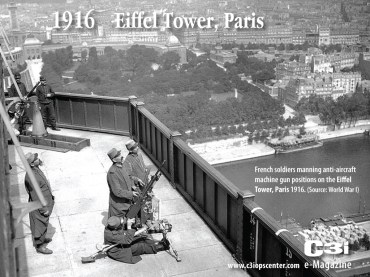
When America entered the war in April 1917, nearly three years of horrific slaughter had bled white the nations of Europe. Daily life in miserable trenches drove men insane; constant artillery bombardment killed without warning; massive infantry assaults through No Man’s Land into barbed wire and machine guns caused the death of millions. New technologies including the machine gun, tank, airplanes, and barbed wire helped make the war the bloodiest the world had ever seen. As American soldiers landed in French ports by the thousands, the exhausted Allies screamed for the American units to be broken up and fed into the French and British lines under the command of French and British officers. General John Pershing, commander of the American Expeditionary Force, refused, insisting that the Americans fight together in their own section of the trench line under American commanders. This rift within the Allied high command almost cost the Allies the war during the German Spring Offensive of 1918, but Pershing’s insistence that American soldiers fight under American commanders sent an important message of American independence to the world.
American soldiers fought bravely and well in battles at Cantigny, Belleau Wood, St. Mihiel and in the Argonne Forest from May to November 1918. With nearly one million troops in the line by the end of the war, the American presence finally convinced the Germans that the war could not be won; they had managed to win a war of attrition with France and Britain, but the influx of an endless supply of American troops meant that there was no way Germany could win. By November 1918, the writing was on the wall and on 11 November 1918, the guns fell silent along the entire line as an armistice was signed, signaling the end of the war.

While white American soldiers fought in their own units in their own part of the line, black troops were relegated to support duty, or sent to the French army to fight under French commanders. Despite the fact that American officers ordered the French not to treat the African-American soldiers with respect—lest they become “uppity” and learn what a non-prejudicial society was like—the French treated the black soldiers with the respect they deserved; the 395th Infantry, a black unit fighting with the French, won 171 commendations for valor. Upon returning home, Jim Crow racism was as rampant as ever in America, and more than 70 returning veterans were lynched in the first year after the end of the war. Still, the experience of black soldiers and the effects of the wartime Great Migration of southern blacks to northern cities had a lasting impact on American society, and sowed the seeds of the Civil Rights Movement.
World War I was a turning point for America economically. With war orders flooding in from Europe, American manufacturers grew rich, and American industrial might began to lead the world. The international financial system set up its capital in New York during this period, and the war catapulted America into a leading role in economic and military affairs.
When President Wilson traveled to Paris for the peace conference that would lead to the Treaty of Versailles, he came armed with his Fourteen Points, an idealistic plan to reorder Europe with the United States as a model for the rest of the world. He failed to gain most of what he wanted as the French and British were more inclined towards a vengeful peace, requiring reparations from Germany, than to any idealistic requests of the United States. The League of Nations, the one victory Wilson managed at the conference, was never ratified by the United States Senate, and, without the United States, it failed as a toothless organization that collapsed in the face of German and Japanese aggression in the 1930s.5Feb1917ComblesFranceWWI